


How to Select the Right FFKM Compound for Your Application
Selecting an FFKM seal is not as simple as specifying “perfluoroelastomer” on a drawing or purchase order.
FFKM is a family of high-performance elastomer compounds. Different formulations are developed for different combinations of chemical exposure, temperature, pressure, mechanical loading, cleanliness and regulatory requirements.
One compound may be optimized for broad chemical resistance. Another may be designed for hot steam and amines. Other formulations prioritize extreme dry-heat stability, low-temperature elasticity, plasma resistance, low particle generation or rapid gas decompression resistance.
This means there is no single FFKM compound that is automatically best for every application.
The correct selection process should answer seven questions:
- Which fluids will contact the seal?
- What are the minimum, normal and maximum temperatures?
- What pressure and pressure cycling will the seal experience?
- Is the seal static or dynamic?
- What mechanical properties and hardness are required?
- Are purity, regulatory or documentation requirements involved?
- What seal life and total operating cost are expected?
This guide explains how to evaluate each factor and how to provide the information a seal manufacturer needs to recommend an appropriate FFKM compound.
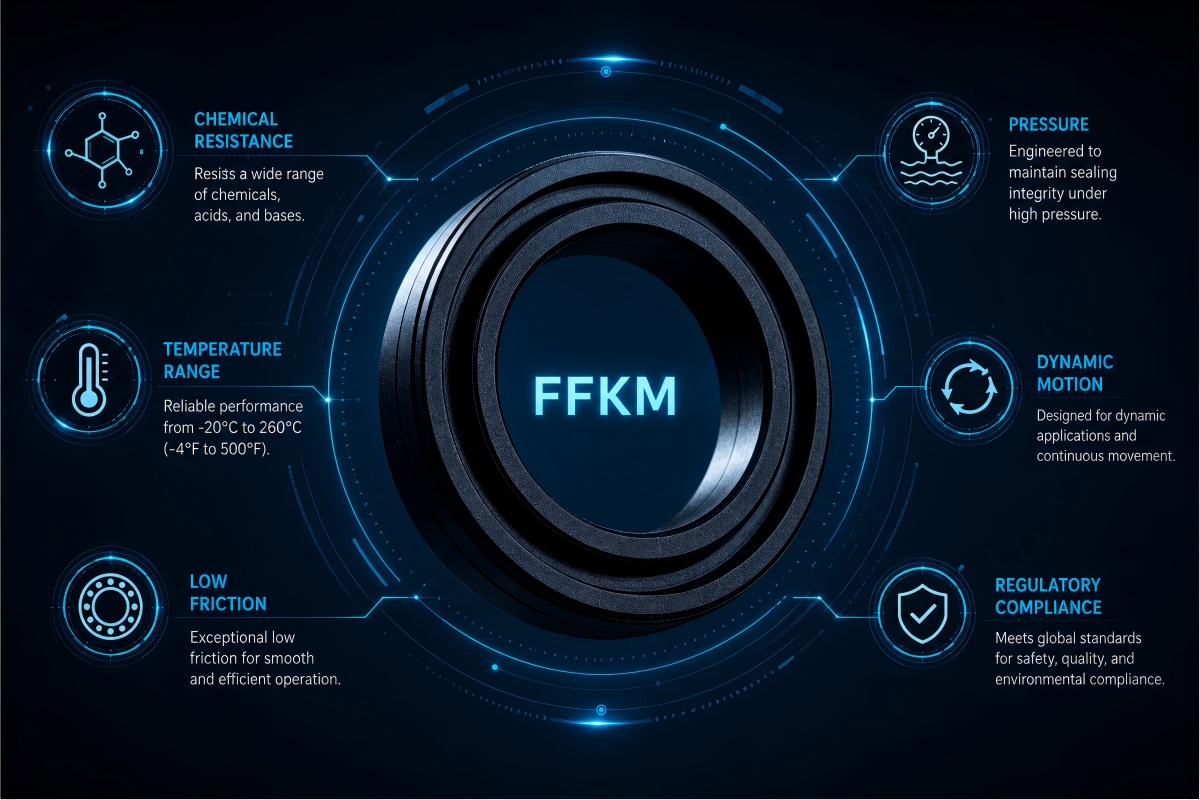
Why FFKM Compound Selection Matters
FFKM materials are selected for some of the most demanding sealing environments, including:
- Aggressive chemical processing
- Semiconductor fabrication
- Pharmaceutical manufacturing
- High-temperature valves
- Vacuum equipment
- Oil and gas systems
- Steam sterilization
- Analytical instruments
- Aerospace equipment
- High-purity fluid handling
In these applications, seal failure can cause much more than a small leak. It may result in:
- Production downtime
- Product contamination
- Loss of expensive process chemicals
- Damage to pumps, valves or chambers
- Reduced semiconductor yield
- Failed sterilization cycles
- Safety risks
- Repeated maintenance labor
Commercial FFKM portfolios therefore contain specialized compounds rather than one universal material. Official supplier ranges include separate solutions for broad chemical service, extreme temperature, steam and hot amines, semiconductor plasma exposure, low-temperature operation and rapid gas decompression.
FFKM Compound Selection at a Glance
| Application condition | Compound property to prioritize |
|---|---|
| Mixed acids, bases and solvents | Broad chemical compatibility |
| Hot water, steam or SIP cycles | Hydrothermal and steam resistance |
| Concentrated or hot amines | Amine-resistant cure system |
| Continuous extreme dry heat | Thermal stability and low compression set |
| Low-temperature startup | Low-temperature elasticity |
| High-pressure gas | RGD resistance and high modulus |
| Dynamic movement | Wear resistance and mechanical strength |
| Semiconductor plasma | Plasma resistance and low particle generation |
| High vacuum | Low outgassing and contamination control |
| Pharmaceutical or food processing | Required compliance and traceability |
| Large extrusion clearance | Higher hardness or backup-ring support |
| Long maintenance interval | Seal-force retention and compression-set resistance |
This table is only a preliminary guide. Final approval should be based on a named compound, its technical data and the complete operating environment.
Step 1: Identify Every Chemical That Contacts the Seal
Chemical compatibility is normally the first selection criterion.
Do not evaluate only the primary process fluid. The seal may also contact:
- Cleaning agents
- Rinse water
- Lubricants
- Sterilization media
- Process gases
- Corrosion inhibitors
- Temporary contaminants
- Flush fluids
- Reaction by-products
A seal that is compatible with the production chemical may fail during cleaning or maintenance.
Provide exact chemical information
For each fluid, specify:
- Chemical name
- Concentration
- Water content
- Temperature
- Exposure duration
- Continuous or intermittent contact
- Whether chemicals are mixed
- Whether the composition changes during the cycle
For example, “acid service” is not enough information. The supplier needs to know whether the fluid is hydrochloric acid, sulfuric acid, nitric acid or an organic acid, together with its concentration and temperature.
Likewise, “solvent” could mean an alcohol, ketone, ester, aromatic hydrocarbon, chlorinated solvent or a complex mixture.
Why the specific compound matters
Some FFKM formulations are intended for the broadest possible range of acids, bases, solvents and mixed process streams. Others are optimized for a narrower but more demanding condition, such as hot amines or high-temperature dry service.
Parker, for example, describes one process-industry FFKM compound as specifically developed for acids, amines, aliphatic media, esters, solvents and hot water or steam. This specialization illustrates why a generic FFKM designation is not enough for final selection.
Use compatibility charts as screening tools
Chemical-resistance databases can help create an initial shortlist. DuPont’s application guide allows users to compare products using selected chemicals, temperatures and pressures. Greene Tweed also publishes a fluid-compatibility system with separate ratings for static and dynamic service.
However, a published rating should not be treated as a service-life guarantee.
Actual performance may change because of:
- Higher chemical concentration
- Increased temperature
- Fluid mixtures
- Pressure
- Seal movement
- Long exposure time
- Process contamination
- Temperature cycling
For critical applications, test the proposed compound in the actual process media.
Step 2: Define the Complete Temperature Cycle
Do not specify only the normal operating temperature.
Provide:
- Minimum startup temperature
- Normal operating temperature
- Maximum continuous temperature
- Short-duration peak temperature
- Cleaning temperature
- Sterilization temperature
- Shutdown temperature
- Frequency of thermal cycling
High-temperature selection
Selected FFKM compounds can operate at temperatures above 300°C, and some commercial grades are rated up to approximately 315°C or 325°C. These ratings apply to specific products and conditions—not to the entire FFKM family.
A compound designed for maximum dry-heat stability may prioritize:
- Thermal aging resistance
- Low compression set
- Seal-force retention
- Dimensional stability
However, it may not be the best compound for hot steam, amines or oxidizing chemicals.
Chemical compatibility decreases with heat
A chemical that produces limited swelling at room temperature may cause rapid deterioration at an elevated temperature.
Heat can accelerate:
- Chemical attack
- Polymer swelling
- Hardening
- Softening
- Loss of tensile strength
- Compression set
- Extraction of compound ingredients
Always evaluate temperature and chemical exposure together.
Low-temperature selection
FFKM is not automatically an ideal low-temperature material.
As temperature falls, an elastomer becomes less flexible. If it cannot recover quickly enough, the seal may lose contact with the mating surface during:
- Startup
- Pressure changes
- Vibration
- Shaft movement
- Rapid decompression
For cold applications, request low-temperature data such as:
- TR10
- Glass transition temperature
- Seal retraction
- Low-temperature leakage results
- Minimum temperature under actual pressure
Special low-temperature FFKM compounds exist, but they may have lower maximum-temperature capability than grades optimized for extreme heat.
Step 3: Evaluate Pressure and Decompression
Pressure influences both compound selection and seal design.
Provide:
- Normal operating pressure
- Maximum pressure
- Pressure direction
- Vacuum level
- Pressure cycling frequency
- Decompression rate
- Gas composition
Extrusion resistance
At high pressure, an elastomer can be forced into the clearance between mating components. This may produce:
- Nibbling
- Torn edges
- Permanent deformation
- Sudden leakage
Higher-hardness compounds can improve extrusion resistance, but hardness should not be increased automatically. A harder seal may require greater assembly force and may provide less effective sealing at low pressure or low temperature.
The solution may involve:
- A higher-modulus compound
- Reduced extrusion clearance
- A backup ring
- A redesigned groove
- A different seal cross-section
Rapid gas decompression
Rapid gas decompression, sometimes called explosive decompression, is a specific risk in high-pressure gas applications.
Gas can diffuse into an elastomer while the system is pressurized. If external pressure drops rapidly, the gas trapped inside the seal expands and may cause:
- Internal cracking
- Blisters
- Splitting
- Surface rupture
Greene Tweed explains that this failure mechanism can affect valves, pumps, compressors and mechanical seals. Specialized FFKM compounds are tested for RGD resistance rather than assumed to be suitable because they belong to the FFKM family.
RGD-resistant material should be considered for:
- Natural gas
- Hydrogen
- Carbon dioxide
- Sour gas
- Downhole equipment
- High-pressure compressors
- Gas injection systems
Ask whether the proposed compound has been tested under a relevant pressure, gas composition, temperature and decompression cycle.
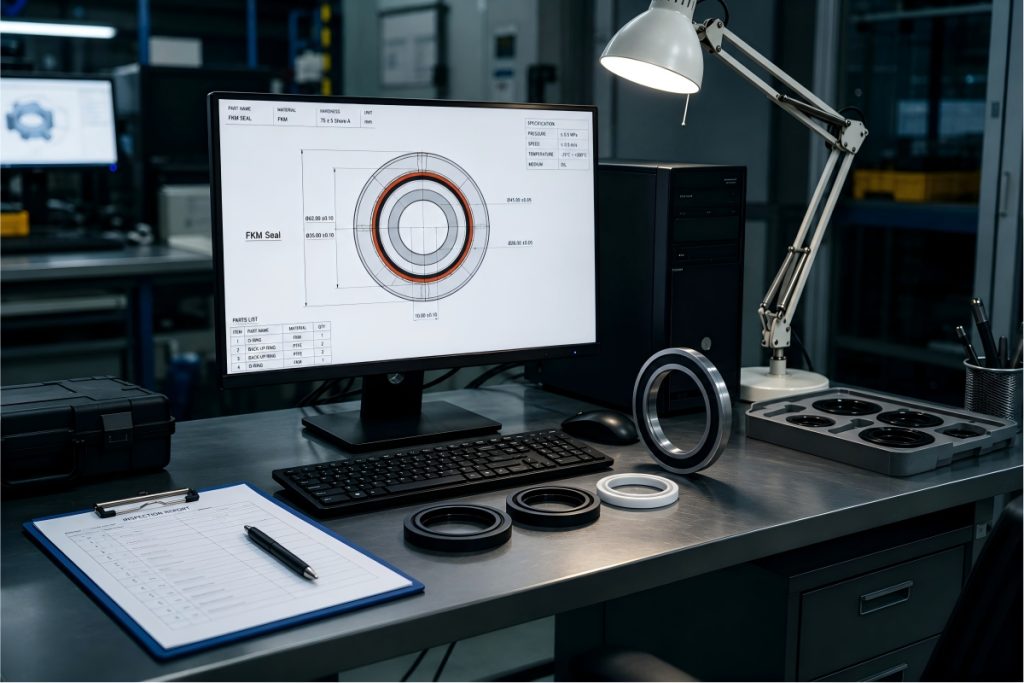
Step 4: Determine Whether the Seal Is Static or Dynamic
Static and dynamic seals impose different material requirements.
Static applications
Static FFKM seals are commonly used in:
- Flanges
- Valve bodies
- Pipe connections
- Chamber doors
- Equipment covers
- Sensor housings
Important properties include:
- Compression-set resistance
- Chemical compatibility
- Seal-force retention
- Thermal stability
- Extrusion resistance
Dynamic applications
Dynamic applications include:
- Reciprocating rods
- Rotating shafts
- Oscillating components
- Moving valve stems
- Pump components
Dynamic sealing also requires attention to:
- Friction
- Wear resistance
- Tear strength
- Lubrication
- Surface finish
- Speed
- Stroke length
- Heat generated by movement
A compound with excellent chemical resistance may still wear prematurely if its mechanical properties are unsuitable for the motion.
Provide:
- Type of movement
- Shaft or rod speed
- Stroke length
- Cycle frequency
- Surface material
- Surface roughness
- Lubrication conditions
- Expected service life
For demanding dynamic applications, a spring-energized PTFE seal or another sealing design may sometimes be more appropriate than an elastomeric O-ring.
Step 5: Select the Appropriate Hardness
FFKM seals are available in different hardness levels, commonly expressed as Shore A durometer.
Hardness affects:
- Installation force
- Low-pressure sealing
- Extrusion resistance
- Compression
- Friction
- Tolerance sensitivity
- Seal recovery
Softer compounds
A relatively softer compound may provide:
- Better conformity to surface irregularities
- Lower assembly force
- Improved low-pressure contact
Potential disadvantages include:
- Greater extrusion risk
- More deformation
- Lower stability in large clearances
Harder compounds
A harder compound may provide:
- Better extrusion resistance
- Greater dimensional stability
- Improved performance under high pressure
Potential disadvantages include:
- Higher installation force
- Reduced conformity
- Greater sensitivity to groove tolerances
- Less effective low-temperature sealing in some conditions
Do not select hardness independently from gland design. Pressure, clearance, seal cross-section and required squeeze must be considered together.
Step 6: Review Compression Set and Seal-Force Retention
Compression set describes the permanent deformation remaining after an elastomer has been compressed for a specified time and temperature.
A seal with excessive compression set may become permanently flattened and lose contact pressure.
This can result in:
- Leakage after shutdown
- Leakage during thermal cycling
- Shorter maintenance intervals
- Failure after repeated sterilization
- Poor vacuum retention
A low published compression-set value can be useful, but test conditions must be reviewed.
Compare:
- Test temperature
- Test duration
- O-ring size
- Percentage compression
- Post-test recovery method
Two values measured under different conditions are not directly comparable.
Seal-force retention can sometimes provide a more application-relevant indication because it measures how much sealing force remains over time.
Prioritize low compression set and strong seal-force retention when the application involves:
- Long-term static compression
- High temperature
- Repeated thermal cycles
- Vacuum
- Steam sterilization
- Long preventive-maintenance intervals
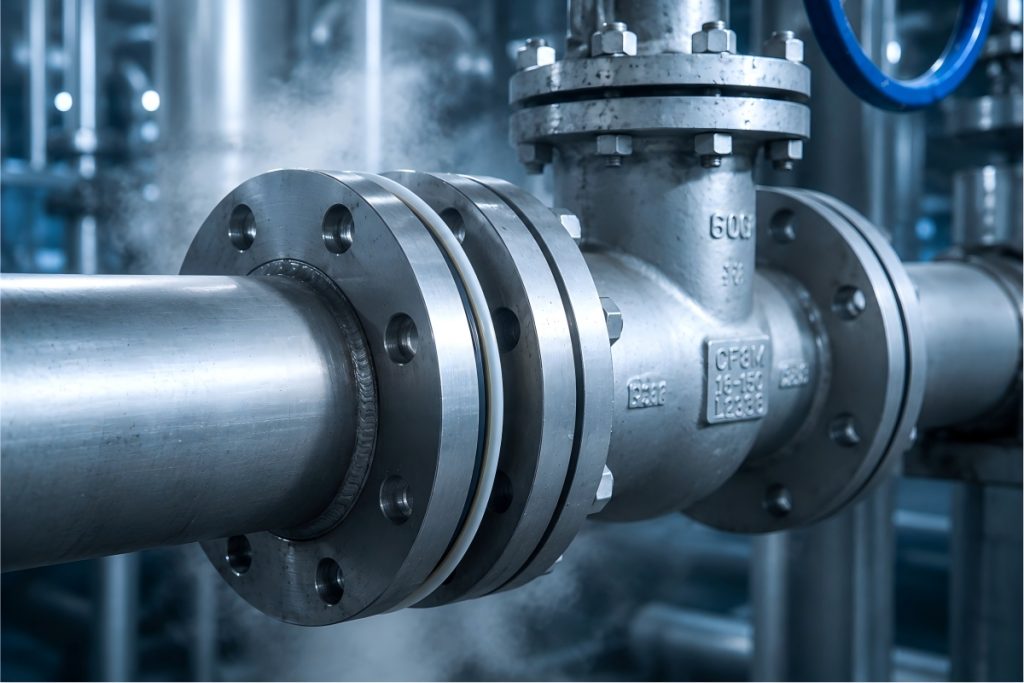
Step 7: Identify Steam, Hot Water and Amine Exposure
Steam and hot amines deserve separate attention because a high dry-air temperature rating does not guarantee resistance to these media.
Steam and hot water
Steam combines:
- Heat
- Water
- Pressure
- Thermal cycling
- Possible cleaning chemicals
A suitable steam-resistant compound should be selected for:
- SIP systems
- Autoclaves
- Pharmaceutical equipment
- Hot-water pumps
- Food-processing equipment
- Steam valves
Some commercial FFKM compounds are specifically designed for hot water, steam and amines, while other grades prioritize maximum dry-heat capability.
For steam applications, provide:
- Saturated or superheated steam
- Temperature
- Pressure
- Cycle duration
- Number of cycles
- Heating and cooling rate
- Other cleaning chemicals
Hot amines
Amines may interact with particular cure systems, especially at high temperatures.
Examples include:
- Monoethanolamine
- Diethanolamine
- Methyldiethanolamine
- Ethylenediamine
- Ammonia solutions
- Proprietary amine blends
Specify:
- Exact amine
- Concentration
- Water content
- Additives
- Temperature
- Pressure
- Continuous or intermittent exposure
Do not assume that the FFKM grade with the highest temperature rating also has the best amine resistance.
Step 8: Define Cleanliness and Contamination Requirements
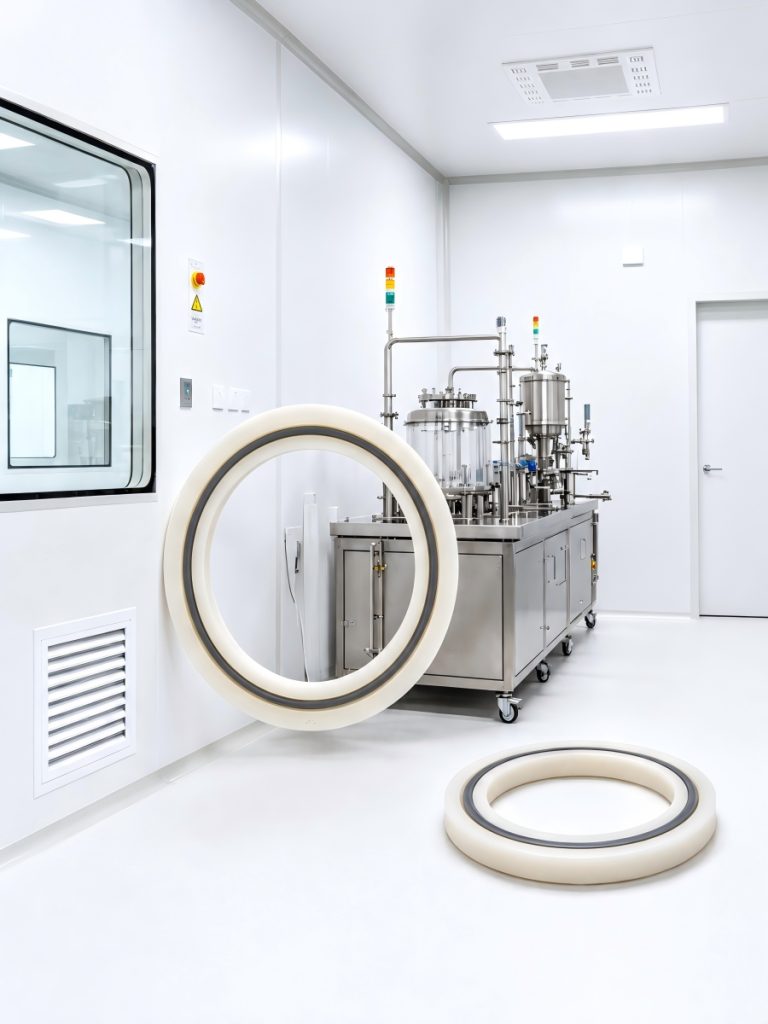
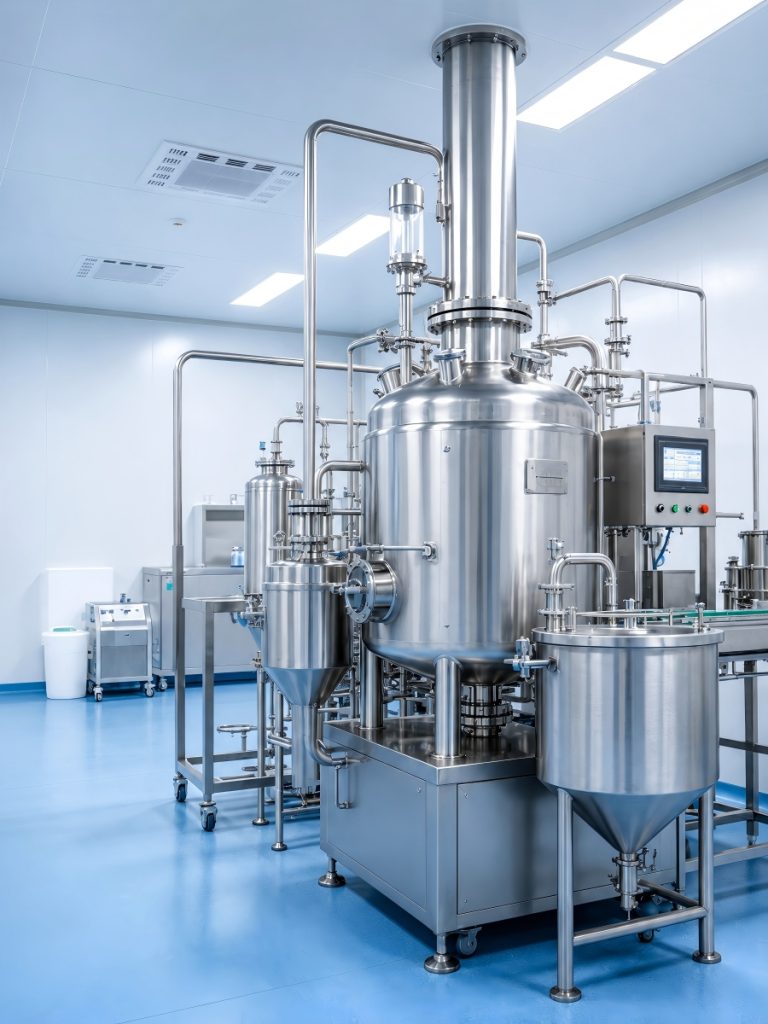
In semiconductor, pharmaceutical, biotechnology and analytical applications, chemical resistance alone is not sufficient.
The compound may also need controlled:
- Particle generation
- Metal-ion content
- Extractables
- Outgassing
- Organic contamination
- Surface cleanliness
- Packaging environment
Semiconductor applications
FFKM compounds for semiconductor equipment may be formulated for:
- Oxygen plasma
- Fluorine plasma
- Dry etching
- CVD
- ALD
- Ashing and stripping
- Remote plasma cleaning
- Wet chemical processes
- High vacuum
Trelleborg’s semiconductor-specific FFKM portfolio, for example, separates compounds according to plasma resistance, purity, particle generation, outgassing and high-temperature stability. Some products are manufactured and packaged in ISO Class 5 cleanroom environments.
This demonstrates why a chemical-processing FFKM compound should not automatically be used in a contamination-sensitive semiconductor chamber.
Vacuum applications
For vacuum sealing, evaluate:
- Outgassing
- Permeation
- Particle generation
- Compression set
- Surface condition
- Vacuum level
- Bake-out temperature
A compound may resist the process gas but still introduce unacceptable contamination.
Step 9: Confirm Regulatory and Documentation Requirements
Regulatory suitability must be confirmed for the specific compound and finished part.
Possible requirements include:
- FDA-related documentation
- USP testing
- EU food-contact requirements
- REACH documentation
- RoHS documentation
- Batch traceability
- Certificate of conformance
- Material test report
- Lot identification
Do not assume that all FFKM seals have the same compliance status.
Commercial portfolios contain specific compounds intended for pharmaceutical, biotechnology or food applications, while other formulations are intended only for industrial or semiconductor service.
Provide the applicable market and end-use requirements before the compound is approved.
Step 10: Review the O-Ring Groove and Seal Geometry
Changing from another elastomer to FFKM may require a gland review.
The groove must accommodate:
- Seal compression
- Manufacturing tolerances
- Thermal expansion
- Chemical swelling
- Pressure
- Extrusion clearance
- O-ring stretch
- Volume expansion
DuPont’s FFKM design guidance states that gland design should account for the selected material’s temperature range, coefficient of thermal expansion and chemical swell. It also recommends reviewing the gland when changing elastomer types.
Information needed for design review
Provide:
- O-ring inside diameter
- Cross-section
- Groove width
- Groove depth
- Hardware tolerances
- Extrusion gap
- Surface finish
- Installation stretch
- Pressure direction
Insufficient groove volume can become especially problematic when chemical swelling and thermal expansion occur simultaneously.
Possible consequences include:
- Excessive contact stress
- Extrusion
- Seal damage
- High friction
- Difficult assembly
- Permanent deformation
Step 11: Compare Total Cost, Not Only Seal Price
FFKM seals are expensive compared with standard elastomers. However, the lowest-priced FFKM compound is not necessarily the lowest-cost solution.
Consider:
- Seal purchase price
- Installation labor
- Equipment disassembly
- Production downtime
- Lost product
- Cleaning and validation
- Equipment damage risk
- Replacement frequency
- Inventory requirements
A higher-performance compound may be justified when it:
- Extends service life
- Reduces unplanned shutdowns
- Prevents contamination
- Supports longer maintenance intervals
- Improves process consistency
Conversely, an extreme-temperature or semiconductor-grade compound may add unnecessary cost when a general chemical-processing grade already meets the application requirements.
The goal is not to choose the most expensive FFKM. The goal is to choose the least expensive compound that reliably satisfies all operating requirements.
Practical FFKM Compound Selection Process
Use the following sequence.
Stage 1: Create an application profile
Document:
- All chemicals
- Concentrations
- Temperature cycle
- Pressure cycle
- Movement
- Existing seal material
- Current failure mode
- Desired seal life
Stage 2: Eliminate incompatible compound categories
Remove compounds that do not satisfy:
- Chemical requirements
- Maximum temperature
- Minimum temperature
- Pressure or RGD requirements
- Regulatory requirements
Stage 3: Compare mechanical properties
Review:
- Hardness
- Tensile strength
- Elongation
- Compression set
- Modulus
- Seal-force retention
- Low-temperature data
Stage 4: Review seal design
Verify:
- Groove fill
- Squeeze
- Stretch
- Extrusion clearance
- Surface finish
- Thermal expansion
- Chemical swell
Stage 5: Test the selected compound
For critical applications, conduct:
- Chemical immersion testing
- Pressure testing
- Thermal cycling
- Steam-cycle testing
- Dynamic wear testing
- Vacuum or outgassing evaluation
- Equipment trials
Stage 6: Approve a named compound
The final drawing or purchase specification should identify:
- Supplier or manufacturer
- Exact compound designation
- Hardness
- Color where relevant
- Required certifications
- Inspection requirements
- Batch traceability
Specifying only “FFKM” leaves too much room for performance variation.
FFKM Selection Checklist for Buyers
Send the following information when requesting a recommendation:
| Required information | Details to provide |
|---|---|
| Process media | Complete chemical names and concentrations |
| Secondary media | Cleaners, steam, rinse fluids and lubricants |
| Temperature | Minimum, normal, continuous maximum and peak |
| Pressure | Normal, maximum, vacuum and decompression rate |
| Movement | Static, reciprocating, rotary or oscillating |
| Speed | Shaft speed, stroke and cycle frequency |
| Dimensions | Seal size, groove dimensions or drawing |
| Existing material | Current compound if known |
| Failure symptoms | Swelling, cracking, leakage, extrusion or wear |
| Service life | Current and desired replacement interval |
| Cleanliness | Particle, metal-ion, outgassing or purity limits |
| Compliance | Required regulatory or quality documentation |
| Quantity | Prototype and expected annual volume |
Common FFKM Selection Mistakes
Selecting only by maximum temperature
The highest-temperature compound may not be the best choice for steam, amines, acids or low-temperature startup.
Using a generic chemical compatibility rating
A rating for “FFKM” does not identify the exact formulation, concentration, test temperature or exposure period.
Ignoring cleaning media
The seal must survive every stage of production, cleaning, sterilization and maintenance.
Assuming all FFKM compounds have the same purity
Industrial chemical-processing compounds and semiconductor-grade compounds may have very different contamination characteristics.
Overlooking rapid gas decompression
Standard chemical resistance does not confirm RGD resistance.
Choosing hardness without checking the groove
A harder compound cannot compensate for an unsuitable gland in every situation.
Replacing another elastomer without a design review
Thermal expansion, chemical swell and compression behavior may change.
Specifying only “FFKM” on the drawing
A generic specification can result in inconsistent performance between batches or suppliers.
Conclusion
Selecting the right FFKM compound requires more than checking whether the material can withstand a particular chemical or temperature.
A reliable selection must consider:
- Every process and cleaning chemical
- Concentration and water content
- Minimum, continuous and peak temperatures
- Pressure and decompression
- Static or dynamic movement
- Hardness and mechanical properties
- Compression-set resistance
- Steam and amine exposure
- Purity and contamination limits
- Regulatory documentation
- Groove design
- Expected service life
- Total operating cost
A general-purpose chemical FFKM may be ideal for mixed process streams. A specialized formulation may be required for extreme dry heat, steam, hot amines, low-temperature operation, semiconductor plasma or high-pressure gas.
The final material should always be identified by a specific compound designation and verified against the real application conditions.
Frequently Asked Questions
Are all FFKM compounds chemically identical?
No. They may use different polymer structures, fillers, curing systems and hardness levels, resulting in different chemical, thermal and mechanical performance.
Should I select the FFKM grade with the highest temperature rating?
Not automatically. A maximum dry-heat rating does not confirm resistance to steam, hot water, amines or a particular chemical mixture.
Can one FFKM compound resist acids, solvents, amines and steam?
Some broad-compatibility compounds are designed for all four categories, but their suitability still depends on concentration, temperature, pressure and exposure time.
Which FFKM compound is best for semiconductor equipment?
It depends on the process. Wet chemical systems, plasma chambers, deposition equipment and high-temperature thermal processes may require different purity, plasma-resistance and outgassing properties.
Which FFKM compound is best for high-pressure gas?
Use a compound specifically developed and tested for rapid gas decompression and extrusion resistance under relevant gases, pressure and temperature.
Is a harder FFKM compound always better for high pressure?
No. Higher hardness can improve extrusion resistance, but groove design, clearance, pressure, temperature and low-pressure sealing must also be considered.
Can I replace an FKM O-ring with an FFKM O-ring of the same size?
Possibly, but the groove should be reviewed for hardness, thermal expansion, chemical swelling and required compression.
Is application testing necessary?
Testing is strongly recommended when the process involves aggressive mixtures, high heat, steam, pressure cycling, contamination-sensitive production or high downtime costs.
What should be written on the purchase specification?
Identify the exact compound, seal size, hardness, required certification, tolerances, inspection criteria and traceability requirements.
Need Help Selecting an FFKM Compound?
Walle Seals manufactures custom FFKM O-rings, gaskets and molded sealing components for chemical processing, semiconductor, pharmaceutical, vacuum, oil and gas, and high-temperature equipment.
Send us:
- Complete process-media list
- Chemical concentrations
- Operating and peak temperatures
- Pressure or vacuum conditions
- Seal movement and speed
- Groove drawing or physical sample
- Current seal material
- Existing failure symptoms
- Required service life and documentation
Our engineering team will review the application and recommend a suitable FFKM compound and seal design.
No responses yet