


FFKM vs FKM Seals: Chemical, Temperature & Cost Guide
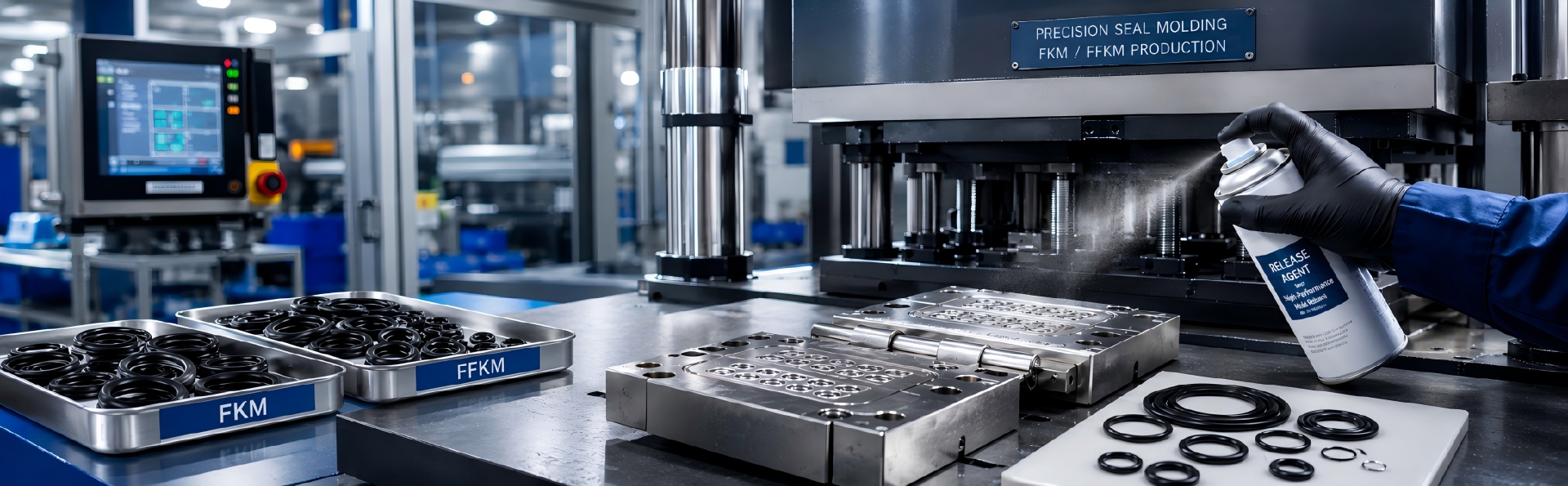
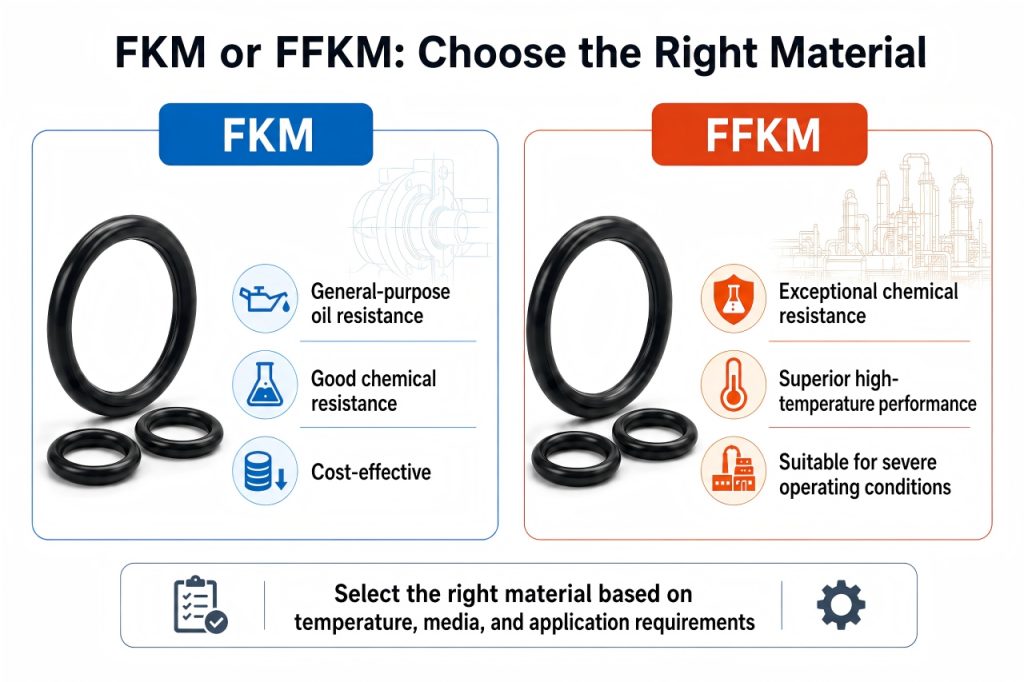
FKM and FFKM are both high-performance fluorinated elastomers used in demanding sealing applications. However, they are not interchangeable in every operating environment.
FKM seals provide an effective balance of temperature resistance, chemical compatibility, mechanical performance and cost. They are widely used in automotive, aerospace, oil and gas, hydraulic and general industrial equipment.
FFKM seals are designed for more extreme conditions. They are commonly selected when equipment is exposed to aggressive chemical mixtures, high process temperatures, steam, vacuum, plasma or contamination-sensitive environments.
The main difference is straightforward:
FKM is usually the more economical choice for demanding but controlled conditions, while FFKM is preferred when chemical attack, extreme heat or seal failure could create unacceptable downtime or process losses.
This guide compares FFKM and FKM seals in terms of chemical resistance, temperature capability, mechanical performance, service life and total cost.
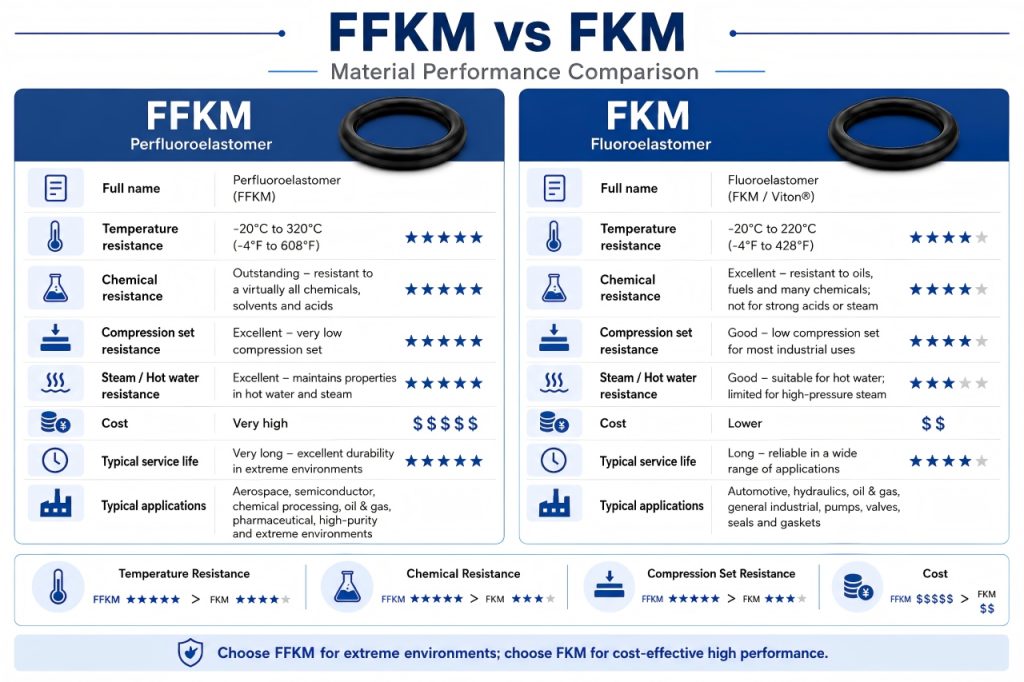
FFKM vs FKM at a Glance
| Property | FKM Seals | FFKM Seals |
|---|---|---|
| Material family | Fluoroelastomer | Perfluoroelastomer |
| Chemical resistance | Excellent against many oils, fuels and chemicals | Broader resistance to aggressive chemicals and mixed media |
| Typical heat resistance | Commonly suitable above 200°C with compound-dependent limits | Selected grades can operate around 300°C or higher |
| Low-temperature performance | Standard grades are limited; specialty grades are available | Often limited unless a low-temperature compound is selected |
| Steam and amine resistance | Requires careful compound selection | Suitable grades provide improved resistance |
| Mechanical performance | Often strong in general industrial applications | Depends heavily on compound and operating conditions |
| Initial cost | Moderate | Substantially higher |
| Best use | Oils, fuels, hydrocarbons and controlled chemical exposure | Extreme chemicals, high heat and critical processes |
| Typical industries | Automotive, aerospace, hydraulics and general industry | Semiconductor, chemical processing, pharmaceutical and vacuum systems |
These values are general comparisons rather than universal material limits. The performance of both FKM and FFKM depends on the polymer type, curing system, fillers, hardness and complete compound formulation.
What Is FKM?
FKM is the ASTM designation for a family of fluorocarbon-based fluoroelastomers. It is sometimes referred to as fluororubber.
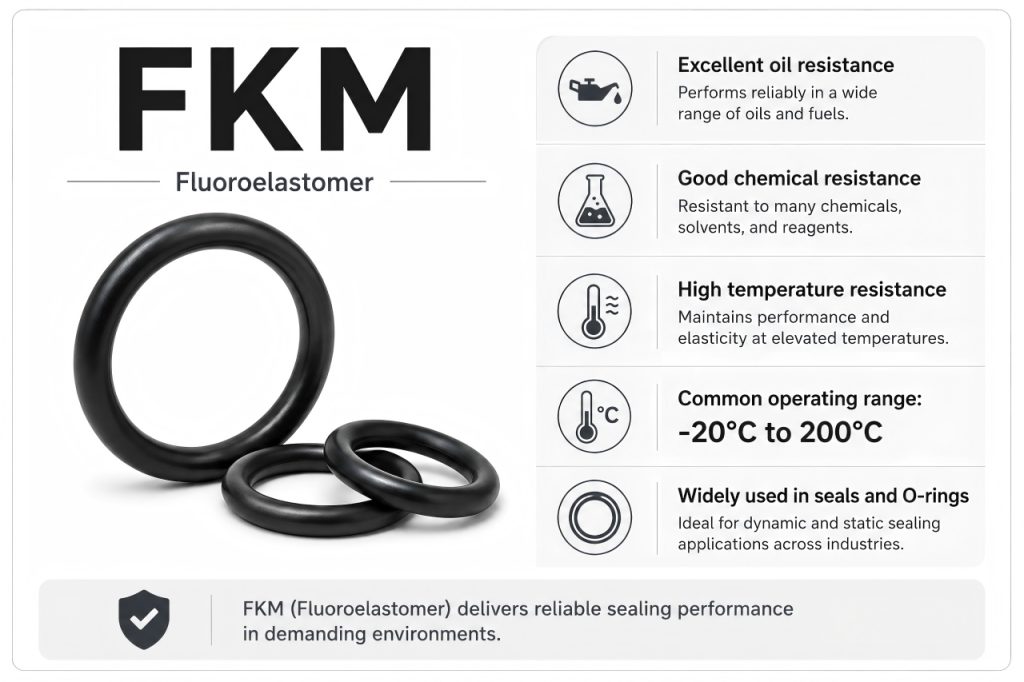
“Viton®” is a well-known brand name for certain fluoroelastomers, but it should not be used as a generic name for every FKM compound.
FKM materials are available in several polymer types. Different types are formulated to improve properties such as:
- Fuel resistance
- Solvent resistance
- Low-temperature flexibility
- Compression set
- Resistance to acids
- Resistance to aggressive automotive fluids
Common FKM applications
FKM seals are frequently used in:
- Automotive fuel systems
- Engines and transmissions
- Aerospace components
- Pumps and valves
- Hydraulic systems
- Oil and gas equipment
- Chemical processing machinery
- Industrial compressors
FKM is often selected because it delivers better heat, fuel and oil resistance than conventional elastomers such as NBR while remaining considerably more economical than FFKM.
What Is FFKM?
FFKM is the ASTM designation for perfluoroelastomer materials.
The polymer structure of FFKM is more completely fluorinated than that of conventional FKM. This structure gives FFKM exceptionally broad chemical resistance while maintaining the elastic sealing behavior required from an elastomer.
FFKM is often described as combining the sealing elasticity of an FKM elastomer with chemical and thermal properties closer to those associated with PTFE. Trelleborg, for example, offers specific FFKM grades for high-temperature applications up to 325°C, although this maximum does not apply to every FFKM formulation. :contentReference[oaicite:1]{index=1}
Common FFKM applications
FFKM seals are used in critical equipment such as:
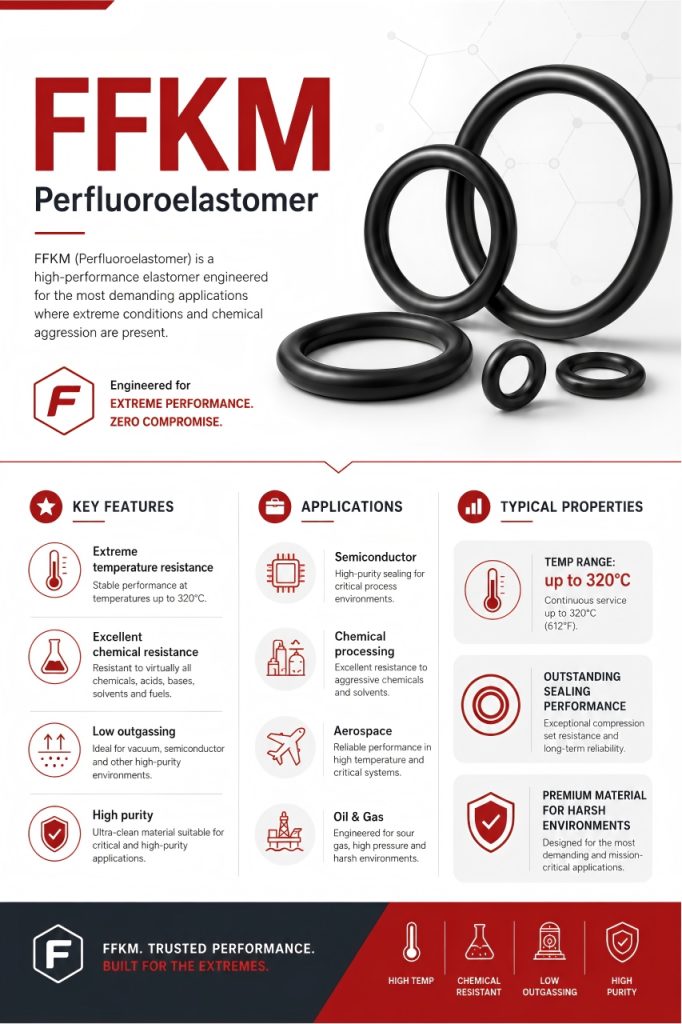
- Semiconductor process chambers
- Plasma and dry-etching equipment
- Chemical reactors
- Aggressive chemical pumps
- Pharmaceutical processing systems
- CIP and SIP equipment
- High-temperature valves
- Vacuum systems
- Oil and gas equipment
- Analytical and laboratory instruments
FFKM is generally considered when conventional elastomers fail too quickly or when a seal failure could contaminate a process, damage equipment or stop production.
Chemical Resistance: FFKM vs FKM
Chemical compatibility is usually the most important difference between FKM and FFKM.
FKM chemical resistance
FKM generally provides excellent resistance to:
- Petroleum oils
- Mineral oils
- Many synthetic lubricants
- Gasoline and diesel fuels
- Aromatic hydrocarbons
- Ozone and weathering
- Many acids
- Many industrial chemicals
However, standard FKM compounds may perform poorly in contact with:
- Ketones
- Esters
- Ethers
- Amines
- Strong alkaline fluids
- Certain polar solvents
- Phosphate ester hydraulic fluids
- Hot water and steam
Special FKM formulations can improve performance in some of these environments, but a general-purpose FKM should not automatically be assumed to be compatible.
The chemical resistance of FKM also changes according to polymer type and fluorine content. Higher-fluorine FKM compounds often provide improved fuel and solvent resistance, while low-temperature grades may make compromises in other areas.
FFKM chemical resistance
FFKM generally provides broader resistance to:
- Strong acids
- Strong bases
- Amines
- Ketones
- Esters
- Organic solvents
- Aggressive cleaning chemicals
- Reactive process gases
- Mixed chemical streams
- High-temperature process fluids
This broad compatibility is one reason FFKM is used in chemical plants and semiconductor equipment where a seal may be exposed to several different process chemicals or cleaning media.
However, FFKM does not mean that every grade is universally resistant to every chemical.
Some FFKM compounds are optimized for:
- High-temperature dry service
- Steam and hot water
- Amines and alkaline fluids
- Plasma resistance
- Low particle generation
- Rapid gas decompression resistance
- Food or pharmaceutical compliance
Selecting only by the name “FFKM” can therefore lead to an unsuitable or unnecessarily expensive seal.
Why temperature changes chemical compatibility
A seal that performs well in a chemical at room temperature may degrade much faster when the same chemical is heated.
Higher temperatures can accelerate:
- Chemical reaction rates
- Swelling
- Hardening
- Softening
- Loss of tensile strength
- Compression set
- Seal extrusion
DuPont notes that temperature ranges measured in dry air can decrease when an elastomer is exposed to chemicals. Actual process temperature and chemical exposure must therefore be evaluated together rather than as separate parameters.
For critical applications, immersion testing in the actual process media may be required. Chemical concentration, contamination, exposure time and temperature should all be included in the test conditions.
Temperature Resistance: FKM vs FFKM
FFKM generally has a higher maximum temperature capability than FKM, but a single universal temperature limit should not be applied to either material family.
FKM temperature range
Many FKM seals can operate continuously at temperatures above 200°C. Certain specialty formulations may support higher temperatures, while low-temperature FKM grades are designed to retain flexibility below the operating range of standard FKM.
A commonly discussed general range for FKM is approximately:
- Low end: around −20°C for many standard compounds
- Upper continuous range: approximately 200°C to 230°C
- Specialty capability: compound-dependent, potentially higher or lower
These figures should only be used for initial screening.
The actual limit depends on:
- FKM polymer type
- Cure system
- Hardness
- Chemical media
- Exposure duration
- Static or dynamic service
- Temperature cycling
- Pressure
FFKM temperature range
FFKM grades are available for a wide range of extreme-temperature applications.
A general screening range may include:
- Low end: approximately −25°C for some grades
- Common high-temperature grades: approximately 250°C to 300°C
- Specialized grades: up to approximately 325°C
Trelleborg lists certain FFKM products for service up to 325°C, while Parker promotes specific high-temperature FFKM grades with limits around 320°C. These are product-specific capabilities and should not be interpreted as the rating of every FFKM seal.
Continuous temperature vs peak temperature
Buyers should distinguish between:
- Normal operating temperature
- Continuous maximum temperature
- Short-duration peak temperature
- Start-up and shutdown temperature
- Cleaning or sterilization temperature
- Minimum storage temperature
- Minimum operating temperature
A material that survives a short temperature peak may not provide reliable sealing at that temperature continuously.
Repeated temperature cycling can also be more damaging than stable operation because expansion and contraction change seal squeeze, contact pressure and stress inside the gland.
Low-Temperature Performance
FFKM is not automatically better than FKM at low temperatures.
Both materials can become less flexible as temperature decreases. If the seal loses elasticity, it may not follow movement, surface variation or pressure changes, resulting in leakage.
Special low-temperature FKM grades can offer significantly better flexibility than general-purpose FKM. Specialized low-temperature FFKM compounds are also available, but they may have different chemical or high-temperature capabilities.
For low-temperature applications, request data such as:
- TR10 value
- Glass transition temperature
- Low-temperature retraction
- Leakage test results
- Minimum service temperature under pressure
A published temperature range alone may not be enough to predict real sealing performance.
Mechanical Performance and Seal Design
FFKM provides superior chemical resistance, but it is not automatically superior in every mechanical property.
Depending on the compound, FKM may provide advantages in:
- Tensile strength
- Tear resistance
- Abrasion resistance
- Dynamic wear
- Ease of installation
- Cost-effective hardness options
FFKM performance is also strongly influenced by:
- Seal hardness
- Cross-section
- Groove dimensions
- Compression
- Extrusion clearance
- Surface finish
- Pressure
- Pressure cycling
- Thermal expansion
FFKM can have different thermal expansion behavior from conventional FKM. DuPont notes that the coefficient of thermal expansion for some perfluoroelastomer parts can be greater than that of a fluoroelastomer with similar hardness. The gland must provide enough space for thermal expansion and any expected chemical swell. :contentReference[oaicite:5]{index=5}
This means an FFKM seal should not always be installed as a direct material substitution without reviewing the gland design.
High-pressure applications
In high-pressure gas service, both FKM and FFKM seals may be vulnerable to rapid gas decompression.
Gas can diffuse into the elastomer while the system is pressurized. If pressure is released too quickly, the trapped gas expands and may cause:
- Internal cracking
- Blistering
- Splitting
- Surface damage
- Explosive decompression failure
Applications involving high-pressure CO₂, hydrogen, natural gas or other gases may require a compound specifically tested for rapid gas decompression resistance.
FFKM vs FKM Cost
FFKM seals have a substantially higher initial purchase price than FKM seals.
The price difference is caused by factors including:
- Higher raw polymer cost
- Specialized compounding
- More demanding molding processes
- Extended curing and post-curing
- Lower production volumes
- Strict contamination control
- More complex quality requirements
- Application-specific testing
However, the seal with the lowest purchase price does not always have the lowest operating cost.
When FKM is more cost-effective
FKM is generally the better economic choice when:
- The process media are fully compatible with the selected FKM grade
- Operating temperatures remain within the compound rating
- Seal replacement is simple and inexpensive
- Downtime has a limited financial impact
- The application does not require ultra-high purity
- The system is not exposed to aggressive chemical mixtures
In these conditions, choosing FFKM may add cost without delivering a meaningful improvement in service life.
When FFKM may reduce total cost
FFKM may provide better total cost of ownership when:
- FKM seals fail frequently
- Equipment downtime is expensive
- Seal replacement requires major disassembly
- Product contamination must be prevented
- Chemical media change during the process
- High-temperature cleaning is performed
- The process involves steam, amines or aggressive solvents
- Seal failure can damage expensive equipment
- Maintenance access is difficult
- Longer preventive-maintenance intervals are required
The correct comparison is therefore not simply:
FKM seal price vs FFKM seal price
A more useful calculation is:
Seal purchase price + installation labor + production downtime + lost material + equipment risk + replacement frequency
A higher-priced FFKM seal may be less expensive over its service life if it significantly increases maintenance intervals or prevents an unplanned shutdown.
When Should You Choose FKM?
FKM is normally the preferred starting point when the application involves:
- Petroleum oils
- Fuels
- Hydrocarbon-based lubricants
- Automotive fluids
- Moderate chemical exposure
- Temperatures within the selected FKM rating
- General industrial static or dynamic sealing
- Cost-sensitive production volumes
FKM is widely available in standard O-ring sizes, hardness options and specialized formulations.
Before selecting it, confirm compatibility with every process fluid, including cleaning agents and temporary contaminants.
When Should You Choose FFKM?
FFKM should be considered when the application involves:
- Aggressive or mixed chemicals
- High continuous temperatures
- Steam sterilization
- CIP or SIP cleaning cycles
- Strong acids or bases
- Amines, ketones or reactive solvents
- Semiconductor process gases
- Plasma exposure
- High vacuum
- Strict cleanliness requirements
- Extremely costly downtime
- Repeated failure of FKM seals
FFKM is especially valuable when process conditions exceed the chemical or thermal capability of standard FKM and the cost of failure is much higher than the cost of the seal.
FKM or FFKM Selection Checklist
Before requesting a quotation, provide the seal manufacturer with the following information.
1. Complete media list
Include:
- Main process fluid
- Chemical concentration
- Cleaning agents
- Lubricants
- Gases
- Contaminants
- Flush fluids
2. Temperature conditions
Provide:
- Minimum operating temperature
- Normal operating temperature
- Maximum continuous temperature
- Short-duration peak temperature
- Cleaning or sterilization temperature
3. Pressure conditions
Include:
- Normal pressure
- Maximum pressure
- Vacuum level
- Pressure cycling
- Decompression rate
4. Type of seal movement
Specify whether the application is:
- Static
- Reciprocating
- Rotary
- Oscillating
For dynamic seals, also provide speed, stroke and lubrication conditions.
5. Seal dimensions and gland design
Send:
- Seal size
- Groove dimensions
- Extrusion clearance
- Surface finish
- Drawing or sample
- Tolerance requirements
6. Regulatory and purity requirements
Identify any requirements related to:
- FDA
- USP Class VI
- EU food contact
- Semiconductor purity
- Extractables
- Metal ion content
- Particle generation
- Batch traceability
7. Service-life expectations
Explain:
- Current seal life
- Desired maintenance interval
- Failure symptoms
- Cost of downtime
- Previous seal material
This information allows the supplier to recommend a specific compound rather than relying only on a generic material name.
Common Selection Mistakes
Assuming every FKM is the same
General-purpose, high-fluorine, low-temperature and specialty FKM compounds can perform very differently.
Assuming every FFKM is universally compatible
FFKM provides broad chemical resistance, but the cure system and formulation still matter.
Choosing only by maximum temperature
Chemical exposure, pressure and duration can reduce the usable temperature range.
Selecting FFKM only because it is more expensive
A higher material price does not guarantee better performance in abrasion, dynamic movement or low-temperature service.
Ignoring cleaning chemicals
A seal may be compatible with the production fluid but fail during cleaning or sterilization.
Using FFKM as a direct drop-in replacement
Thermal expansion, hardness and chemical swell may require a gland review.
Conclusion
FKM and FFKM seals both provide high-performance sealing, but they are intended for different levels of operating severity.
Choose FKM when you need:
- Excellent oil and fuel resistance
- Reliable high-temperature performance
- Good mechanical properties
- A cost-effective industrial sealing material
Choose FFKM when you need:
- Broader chemical compatibility
- Extreme high-temperature capability
- Resistance to aggressive or mixed process media
- Longer service life in critical equipment
- Reduced risk of contamination and unplanned downtime
The best material cannot be selected from temperature alone. Chemical concentration, pressure, movement, cleaning conditions, seal design and maintenance cost must also be considered.
For critical applications, the final decision should be based on a specific compound datasheet, chemical compatibility evaluation and, where necessary, testing under actual operating conditions.
Frequently Asked Questions
Is FFKM the same as FKM?
No. FKM is a fluoroelastomer family, while FFKM is a more completely fluorinated perfluoroelastomer family. FFKM generally offers broader chemical and higher-temperature resistance.
Is Viton the same as FFKM?
No. Viton® is a brand associated primarily with FKM fluoroelastomers. FFKM is a different material category.
Is FFKM resistant to every chemical?
No material is automatically suitable for every chemical and operating condition. FFKM grades provide broad resistance, but the specific formulation, temperature, concentration and exposure time must be checked.
Can FFKM directly replace an FKM O-ring?
Sometimes, but not always. Although the same standard size may be available, differences in hardness, thermal expansion and chemical swell can affect gland performance.
Which is better for steam, FKM or FFKM?
Some specialized FKM compounds can resist steam, but general-purpose FKM may degrade in hot water or steam. Specific steam-resistant FFKM grades are often preferred for severe sterilization and process conditions.
Why are FFKM seals more expensive?
FFKM uses more expensive polymers and requires specialized compounding, molding, curing and quality-control processes. Production volumes are also generally lower than for standard FKM.
Is FFKM always worth the additional cost?
No. If a suitable FKM compound provides the required service life, FKM is normally more economical. FFKM becomes attractive when frequent seal failure, downtime, contamination or maintenance costs outweigh the higher purchase price.
Need Help Choosing Between FKM and FFKM?
Walle Seals manufactures custom FKM and FFKM O-rings, gaskets and molded sealing components for chemical processing, semiconductor, pharmaceutical, vacuum, oil and gas, and industrial equipment.
Send us your:
- Process media
- Operating temperature
- Pressure
- Seal dimensions
- Drawing or sample
- Required service life
Our engineering team will review your working conditions and recommend a suitable, cost-effective sealing solution.
No responses yet