


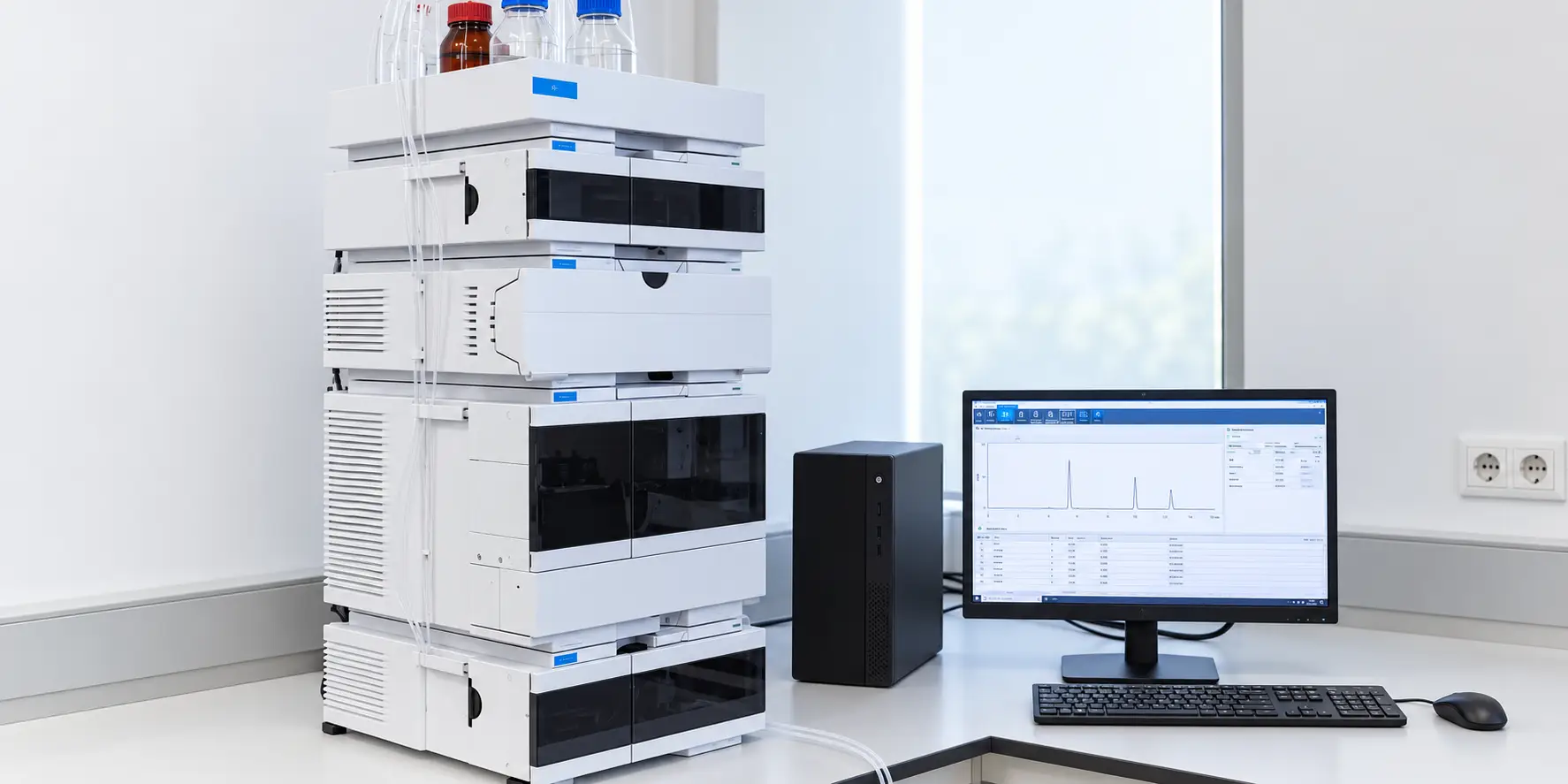
Types of HPLC Pump Seals: Piston, Plunger, Wash and Valve Seals
Map every sealing interface inside an HPLC or UHPLC pump—then connect its position and function to leakage, pressure stability, solvent compatibility and service life.
The HPLC or UHPLC pump must deliver mobile phase at a precise, repeatable flow rate while maintaining stable pressure throughout every chromatographic run. Several small sealing and flow-control components make that possible.
Depending on the instrument, the pump may contain piston or plunger seals, wash or rinsing seals, check-valve interfaces, purge-valve seals and supporting rings. Their condition directly affects pressure, flow stability, solvent leakage, retention-time repeatability, baseline stability and maintenance frequency.
The primary pump seal contains the high-pressure mobile phase, the wash seal protects and cleans the rear side of the primary seal and plunger, and the valve system controls solvent flow direction.
POSITION → FUNCTION → SYMPTOM
Quick Overview of HPLC Pump Seal Types
Not every pump uses the same architecture or terminology. Use this interactive map to identify the sealing role before selecting a replacement.
Select a component
Contains the high-pressure mobile phase.
This dynamic seal maintains contact around the reciprocating element while balancing leakage resistance against friction and wear.
Mobile-phase leakage · unstable pressure · reduced flow
| Seal or component | Main function | Typical location | Common failure symptoms |
|---|---|---|---|
| Piston / plunger seal | Contains high-pressure mobile phase | Around the reciprocating piston or plunger | Leakage, unstable pressure, reduced flow |
| Wash / rinsing seal | Contains wash fluid and protects the primary seal | Behind the high-pressure seal | Wash-fluid leakage, salt deposits, shortened primary-seal life |
| Check-valve sealing interface | Controls one-way mobile-phase flow | Pump inlet and outlet | Pressure ripple, loss of prime, unstable flow |
| Purge / switching-valve seal | Seals controlled flow-routing paths | Purge or switching valve | External leakage, incomplete pressure build |
| Support / backup component | Supports the high-pressure seal | Adjacent to the primary seal | Extrusion, deformation, premature wear |
Piston seal vs plunger seal
These terms often describe the same primary high-pressure function. Thermo Fisher commonly uses “piston seal,” while Shimadzu and Waters often use “plunger seal.” Always follow the instrument model’s terminology and part configuration.
PRIMARY HIGH-PRESSURE SEAL
HPLC Piston Seals
The piston seal is the primary dynamic sealing element around the reciprocating piston. It must contain high-pressure solvent while permitting smooth movement, resisting chemical attack, maintaining geometry and preventing extrusion.
What the seal must do
- Contain high-pressure solvent
- Allow reciprocating motion
- Minimize friction
- Resist chemical attack
- Maintain dimensional stability
- Resist extrusion
Common systems
- Virgin PTFE
- Filled PTFE
- Graphite-filled PTFE
- Polyethylene
- UHMWPE
- Proprietary polymers
Look beyond pressure
- Mobile phase
- Piston material and finish
- Flow and cycle rate
- Required lifetime
- Groove and support geometry
Manufacturer example: Agilent describes UHMWPE and graphite-filled PTFE CrossLab pump seals; Shimadzu also lists graphite-filled PTFE and polyethylene options for selected plunger-seal configurations.
THE SLIDING COUNTERFACE
HPLC Plunger Seals
Where the pump manufacturer uses the term “plunger,” the plunger seal performs the same primary high-pressure function. Precision plungers are commonly sapphire or ceramic, and their surface condition directly controls seal life.
- Scratches
- Abrasive deposits
- Salt crystals
- Surface damage
- Misalignment
- Mobile-phase leakage
- Pressure fluctuation
- Reduced pressure or flow
- Salt around the pump head
- Shortened seal life
- Reproducibility changes
A pump seal problem may first appear as a chromatography problem—such as retention-time shifts or baseline noise—rather than an obvious external leak.
REAR-SIDE PROTECTION
HPLC Wash Seals
A wash seal—also called a seal-wash seal, secondary seal or rinsing seal—sits behind the primary high-pressure seal. It contains a separate wash-fluid circuit that flushes the rear side of the primary seal and exposed plunger.
Prevent deposits
- Flush mobile-phase residue
- Remove precipitated salts
- Lubricate the plunger region
- Protect the primary seal
- Reduce abrasive wear
What it contains
- Guides wash solvent
- Prevents wash-fluid leakage
- Protects the piston
- Separates the wash region
- Uses PTFE, PE or proprietary polymers
Inspect the wash system
- Wash solution leakage
- Fast reservoir loss
- Salt on the plunger
- Primary-seal wear
- Contaminated tubing
- Liquid near the wash housing
ABRASIVE DAMAGE CYCLE
Why Buffer Salts Damage HPLC Pump Seals
Buffered mobile phases create a particularly demanding environment. Small amounts of buffer can migrate past the primary seal; when the solvent evaporates, hard salt crystals remain on the moving piston and are dragged repeatedly across the sealing surface.
- Scratched piston or plunger
- Abraded seal lip
- Increased leakage
- Pressure instability
- Shorter maintenance intervals
- Use the specified seal-wash system
- Keep the wash solvent fresh
- Do not let salts dry on the plunger
- Inspect both seal and counterface
- Follow the instrument procedure
Manufacturer example: Agilent strongly recommends seal washing during prolonged use of buffer concentrations around 0.1 M or higher. The exact wash solution and procedure must still follow the instrument manufacturer’s instructions.
ONE-WAY FLOW CONTROL
HPLC Valve Seals and Check-Valve Interfaces
“Valve seal” can refer to several very different constructions: inlet and outlet check valves, purge valves, proportioning valves or switching valves. Some use discrete polymer seals; others rely on precision ball-and-seat, cartridge or face-sealing interfaces. Identify the valve design before specifying a replacement.
These symptoms do not automatically prove that the polymer piston seal has failed. Pump troubleshooting must consider both the primary seal and the check valves.
CONTROLLED BYPASS
Purge and Flow-Control Valve Seals
A purge or drain valve routes mobile phase away from the normal downstream path during priming, solvent replacement, air removal and maintenance. Depending on the instrument, sealing may use polymer seats, face seals, O-rings, rotor/stator interfaces or precision metal and ceramic components.
Liquid appears around the valve or its housing.
Flow escapes to the unintended path inside the valve.
The pump cannot build or maintain the expected pressure.
SEAL-STACK GEOMETRY
Support Rings and Backup Components
A high-pressure seal rarely works in isolation. Support rings, backup rings, holders and seat components stabilize the primary seal, control deformation, resist extrusion and preserve the intended lip geometry.
Control movement
Keep the primary seal located and aligned during reciprocation.
Resist extrusion
Support vulnerable polymer regions under peak pressure and cycling.
Maintain geometry
Hold the lip, seat and gland relationship required by the design.
Design implication: Thermo Fisher separately identifies piston seals and support rings in Vanquish pump-head documentation. Reverse engineering should therefore capture the full assembly rather than the seal dimensions alone.
POLYMER TRADE-OFFS
HPLC Pump Seal Material Comparison
No single material leads every category. The correct compound must balance the complete fluid mixture, pressure, friction, wear, seal profile and supporting hardware.
| Material | Chemical resistance | Wear resistance | Pressure capability | Friction | Typical role |
|---|---|---|---|---|---|
| Virgin PTFE | Excellent | Moderate | Moderate | Very low | Chemical-resistant sealing |
| Filled PTFE | Excellent* | Improved | Improved | Low | High-cycle piston seals |
| UHMWPE | Very good for suitable media | Excellent | Good; design dependent | Low | Pump / piston seals |
| PE | Application-specific | Good | Pressure dependent | Low | Normal-phase pump seals |
| PEEK | Very good | Excellent | Excellent | Higher | Support, valve and high-load components |
*A filler system can change chemical compatibility. Confirm the exact grade against the full solvent, buffer and additive mixture.
COMPLETE MOBILE PHASE
Solvent Compatibility Matters
The seal sees more than the primary solvent name. Evaluate every constituent, concentration and cleaning condition in the real operating cycle.
Same size does not mean same application.
Agilent recommends different polyethylene pump and wash seals for prolonged normal-phase use with solvents such as hexane, and notes different pressure limitations for these seals. Match chemistry and pressure together.
OBSERVE THE SYSTEM
Common HPLC Pump Seal Failure Symptoms
External solvent leakage
Possible causes: worn primary seal, damaged plunger, incorrect installation or material incompatibility.
Pressure fluctuations
Possible causes: primary-seal leakage, contaminated check valve, air in the pump or worn components.
Retention-time shifts
Excessive leakage can reduce flow repeatability and move retention times.
Increased baseline noise
Unstable solvent delivery can contribute to inconsistent chromatographic performance.
Salt around the piston
Look for buffered mobile phase, weak seal washing and leakage past the primary seal.
Rapid seal wear
Inspect for scratches, abrasive deposits, wrong material, excessive pressure or installation damage.
SYMPTOM-TO-COMPONENT MAP
How to Diagnose Which Seal Is Failing
Use the location and a pattern of symptoms to narrow the search. One symptom alone is rarely enough.
| Observed symptom | Components to inspect first |
|---|---|
| Mobile phase leaking behind pump head | Primary piston / plunger seal |
| Wash fluid leaking | Wash seal and wash housing |
| Salt deposits on plunger | Primary seal and wash system |
| Pressure pulsation | Check valves, air and primary seals |
| Pump cannot maintain pressure | Primary seal, purge valve and check valves |
| Short seal life | Plunger surface, compatibility and wash system |
| High friction or wear | Primary seal material and piston surface |
| Difficulty priming | Inlet check valve, pump seals and air in flow path |
SPECIFICATION INPUTS
How to Select the Right HPLC Pump Seal
A useful seal request connects the hardware, duty cycle and chemistry. These seven input groups prevent most avoidable selection errors.
Instrument
Manufacturer, model, pump module, HPLC or UHPLC, and seal location.
Seal type
Primary piston/plunger, wash, valve interface or support ring.
Mobile phase
All solvents, buffers, acids, bases and additives with concentration.
Pressure
Normal, maximum and cycling. UHPLC demands much greater extrusion resistance.
Dimensions
Plunger diameter, seal ID/OD/height, gland dimensions, drawing or sample.
Plunger
Sapphire, ceramic or other material; surface condition and alignment.
Failure history
Leakage, instability, wear, swelling, deposits and actual service life.
RECONSTRUCT THE ORIGINAL SYSTEM
Reverse Engineering Requires More Than Measuring
A used seal is evidence—but not a reliable master dimension. Service can permanently change both its size and shape.
- Used seal dimensions
- New reference sample
- Pump-head and gland geometry
- Plunger diameter and condition
- Seal orientation and support parts
- Pressure and solvent chemistry
Two seals can have identical nominal dimensions but very different service lives because their polymer compounds, fillers, profiles or supporting components differ.
SEVEN AVOIDABLE ERRORS
Common HPLC Pump Seal Selection Mistakes
Treating “piston” and “plunger” as automatically different parts
Map manufacturer terminology to the actual primary-seal function.
Selecting by dimensions alone
Verify pressure, solvent mixture, compound and support geometry.
Ignoring the wash seal
Inspect the wash circuit whenever the primary seal is serviced.
Installing a new seal on a damaged plunger
Replace or correct scratched and contaminated counterfaces first.
Calling every pressure fluctuation a seal failure
Rule out check valves, air and purge-valve bypass.
Using the wrong material for normal-phase solvents
Follow the pump maker’s chemistry and pressure limitations.
Ignoring seal orientation
Install directional lips or energized seals in the specified direction.
LIFETIME CONTROL
Preventive Maintenance Tips
- Use seal wash when required
- Keep wash solvent fresh
- Never let buffer salts dry
- Inspect and replace damaged plungers
- Use clean installation tools
- Avoid scratching sealing surfaces
- Confirm seal orientation
- Track pump pressure stability
- Record real service life
- Follow the manufacturer’s interval
Maintenance example: Thermo Fisher recommends piston-seal replacement when excessive leakage is present and wash-seal replacement within defined pump-head maintenance procedures.
RFQ DATA SHEET
HPLC Pump Seal Selection Checklist
Send the following information with a replacement or custom-seal request. More complete inputs shorten the material and geometry review.
| Parameter | Information required |
|---|---|
| Instrument | Manufacturer and model |
| Pump | Pump model or module number |
| Seal type | Piston, plunger, wash or valve |
| Mobile phase | Complete solvent and buffer composition |
| Pressure | Normal and maximum |
| Temperature | Normal and maximum |
| Plunger | Material, diameter and surface condition |
| Seal dimensions | ID, OD, thickness and profile |
| Drawing | Pump-head or seal drawing if available |
| Sample | New or used physical sample |
| Current material | Exact compound or best available description |
| Failure symptom | Leakage, wear, swelling or pressure instability |
| Service life | Current and desired replacement interval |
| Quantity | Prototype and estimated annual demand |
SYSTEM-LEVEL VIEW
One Pump, Several Sealing Functions
Dimensions alone are not enough. The material, profile, orientation and supporting hardware must match the actual instrument and operating environment.
QUICK ANSWERS
Frequently Asked Questions
A piston seal is the primary dynamic seal around the reciprocating piston in an HPLC pump. It prevents high-pressure mobile phase from escaping from the pump chamber.
Often, yes. Manufacturers use “piston” and “plunger” differently; both terms can describe the primary seal around the reciprocating pump element.
A wash seal is part of the seal-wash circuit behind the primary seal. It contains wash fluid and allows the rear of the primary seal and plunger to be flushed.
Seal wash removes mobile-phase residue and precipitated salts behind the primary seal, helping protect the piston and extend seal life.
Common options include PTFE, filled PTFE, UHMWPE, PE and proprietary engineered polymers, depending on pump design and service conditions.
Common causes include wear, solvent incompatibility, abrasive buffer deposits, a scratched plunger, excessive pressure and incorrect installation.
Yes. A damaged plunger can accelerate wear and cause premature leakage, so inspect it whenever the seals are replaced.
Possible causes include piston-seal leakage, contaminated check valves, air in the pump, purge-valve problems and other flow-path issues.
Not necessarily. UHPLC can impose much higher pressure and tighter performance requirements, so material, geometry and pressure capability must be confirmed for the specific pump.
Yes. Custom seals can be developed from drawings, samples and pump geometry, but pressure, solvent chemistry, plunger condition and the original material should also be evaluated.
Need a Custom HPLC Pump Seal?
Walle Seals develops precision piston, plunger, wash, valve and engineered polymer sealing components for chromatography pumps.
Discuss your application →- Instrument and pump model
- Seal drawing or sample
- Plunger diameter and condition
- Operating and maximum pressure
- Solvents, buffers and additives
- Current material and failure symptoms
- Target life and annual quantity
No responses yet