




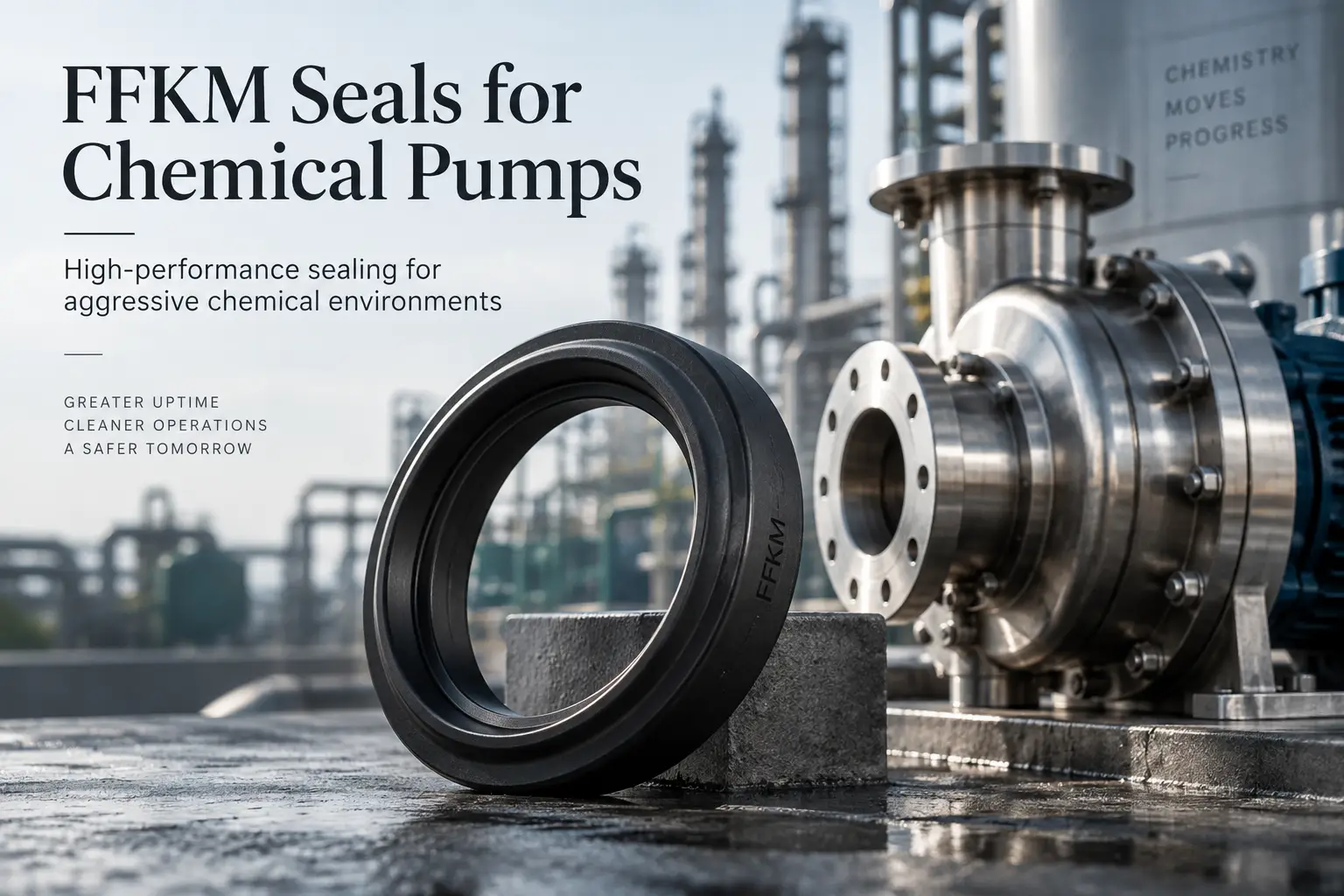
FFKM Seals for Chemical Pumps: Material Selection, Applications and Failure Prevention
Connect process chemistry, temperature, pressure, groove design and maintenance cost to the FFKM compound and seal location that actually need protection.
Chemical pumps combine aggressive media with elevated temperature, pressure cycling, vibration and long operating periods. Conventional NBR, EPDM and even FKM may provide insufficient resistance or service life when several of these loads occur together.
Perfluoroelastomer compounds combine elastomeric recovery with exceptionally broad chemical and thermal resistance. But specifying “FFKM” alone does not identify the right compound, geometry or seal location.
The correct chemical-pump seal must be selected for the exact process fluid, concentration, temperature, pressure, pump design and seal location.
MULTI-LOAD ENVIRONMENT
Why Chemical Pumps Are Difficult to Seal
A seal can survive one load and still fail when chemistry, heat, pressure and equipment movement interact. Use this first-pass selector to identify the properties that deserve the closest compound and hardware review.
Select the dominant exposure
Identify the exact acid before choosing the grade.
Sulfuric, nitric, hydrochloric and hydrofluoric acids create different compatibility demands. Concentration, water content and temperature can change the result.
Acid identity · concentration · temperature · oxidizing character
Screening aid only. Final selection requires compound-specific compatibility data and the actual pump conditions.
Property change
Swelling, shrinkage, softening, hardening, cracking and tensile loss can change sealing force and groove fill.
Accelerated reaction
A compound that performs at 25°C may behave very differently in the same chemical at 150°C.
Mechanical loading
High pressure and cycling increase deformation, extrusion and fatigue risk.
System movement
Vibration, shaft movement and thermal cycling load even nominally static O-rings.
Downtime multiplier
A small O-ring can trigger pump removal, chemical cleanup, production loss and a full seal rebuild.
SECONDARY CONTAINMENT
Where FFKM Seals Are Used in Chemical Pumps
The exact locations depend on pump architecture. FFKM typically protects secondary and static interfaces rather than replacing the precision hard faces that create the primary mechanical-seal interface.
FACESFFKM
SECONDARYCARTRIDGESHAFT / SLEEVEPROCESS →
A physically small secondary O-ring can compromise the entire pump sealing system when process fluid bypasses the faces, sleeve, cartridge or gland.
ARCHITECTURE CHANGES THE DUTY
Which Chemical Pumps May Use FFKM?
Continuous process duty
Chemical plants, refineries, pharmaceutical production, solvent handling and acid transfer.
- Mechanical seal O-rings
- Casing and cartridge seals
- Static joints
No shaft penetration
Eliminates one leakage path but still requires static seals and internal materials compatible with the process.
- Casing O-rings
- Containment interfaces
- Severe-acid applications
Concentrated, pulsating service
Acids, alkalis, bleaching chemicals, solvents and treatment chemicals at controlled delivery rates.
- Valve seals
- O-rings
- Custom components
Complex exposure
Aggressive vapors, high temperature, vacuum and mixed solvents require a construction-specific review.
- Static interfaces
- Gas-rich media
- Thermal cycling
Field-example context: Published application cases can show why FFKM is considered, but their service life is not a universal prediction. Match the actual pump, compound and operating conditions.
UPGRADE WITH A REASON
FFKM vs FKM in Chemical Pumps
FKM remains an excellent and economical industrial elastomer for hydrocarbons, oils, fuels and many controlled chemical services. FFKM becomes valuable where FKM chemistry or temperature limits drive repeated maintenance.
| Property | FKM | FFKM |
|---|---|---|
| Hydrocarbon resistance | Excellent | Excellent |
| Broad solvent resistance | Very good | Exceptional |
| Strong acid resistance | Compound-dependent | Generally broader |
| Hot amine resistance | Limited for many grades | Specialized grades available |
| Steam resistance | Grade-dependent | Specialized grades available |
| High-temperature capability | High | Very high |
| Initial cost | Moderate | High |
| Best use | Controlled chemical conditions | Severe and mixed chemical service |
FFKM is not automatically “better.” If FKM already meets the required maintenance interval, the higher-cost material may not improve the business result.
ACID IDENTITY MATTERS
FFKM Seals for Acid Pumps
Acid service is a common reason for considering FFKM, but sulfuric, nitric, hydrochloric, phosphoric, acetic and hydrofluoric acids do not create one uniform compatibility problem.
Concentration changes the exposure
- Concentration
- Temperature
- Water content
- Other process chemicals
Field cases can illustrate potential improvement, but they do not predict universal seal life.
Oxidizing service needs the right formulation
- Strong oxidizing character
- Compound-specific testing
- Temperature-specific validation
- Exact test conditions
A grade designed for heat alone may not be the correct oxidizing-media grade.
Do not select an FFKM compound for an acid pump based only on the word “acid.” Identify the exact acid, concentration, water content, temperature and mixture.
MIXTURE, NOT LABEL
FFKM Seals for Solvent Pumps
Suitable FFKM compounds can provide broad resistance across several solvent families, reducing swelling where conventional elastomers struggle. The complete production and cleaning mixture must still be reviewed.
CURE-SYSTEM CHALLENGE
FFKM Seals for Amine Pumps
Hot and concentrated amines are particularly demanding for some elastomer cure systems. A compound optimized for maximum dry-heat capability is not automatically the best amine-resistant formulation.
Specify a formulation validated for the exact amine, concentration and temperature.
“Extreme temperature” and “hot amine resistant” are different compound requirements. Select for the chemistry actually present.
WET HEAT + PRESSURE
FFKM Seals for Hot Water and Steam Pumps
Hot process water, steam cleaning, CIP and SIP cycles combine heat, water, pressure and repeated thermal change. A high dry-air rating alone does not establish steam resistance.
CHEMICAL-SERVICE LIMIT
Temperature Requirements
Commercial FFKM compounds cover very different operating ranges. Some portfolios extend to about 320°C / 608°F, while process-specific grades may use a lower temperature limit to optimize resistance to a particular chemistry.
Chemical-service temperature
Temperature can accelerate swelling, degradation, hardening, softening and loss of strength. A maximum rating measured in air does not replace immersion data for the real chemical.
LONG-TERM SEALING FORCE
Compression Set in Pump O-Rings
Many pump O-rings remain compressed for long periods. If an elastomer permanently loses its ability to recover, contact force can fall below the level required to contain fluid or vacuum—especially after shutdown or cooldown.
PRESSURE THROUGH CLEARANCE
Pressure and Extrusion
Chemical resistance cannot prevent elastomer from being forced into a hardware gap. High pressure, heat, excessive clearance, a soft compound and chemical swelling can combine to extrude and tear the seal.
- Nibbled edges
- Torn material
- Material missing on one side
- Sudden leakage
Do not solve extrusion simply by choosing the hardest available FFKM. Review pressure, temperature, swelling, clearance, squeeze and backup geometry together.
GAS TRAPPED IN ELASTOMER
Rapid Gas Decompression
Most liquid chemical pumps do not see severe RGD, but compressed-gas or gas-rich service can drive gas into the elastomer. Rapid depressurization lets that gas expand internally faster than it can escape.
CO₂, hydrogen, natural gas or process gas diffuses into the seal.
External pressure falls faster than dissolved gas can leave.
Blisters, cracks and splits form within the cross-section.
If gas exposure is credible, specify a compound validated for rapid gas decompression—not simply a chemically compatible FFKM.
CHEMISTRY BECOMES GEOMETRY
Chemical Swell and Groove Fill
A seal can pass a basic compatibility screen yet swell enough to create a mechanical failure. Chemical volume change and thermal expansion consume the free volume designed into the groove.
EVERY CONTACT FLUID
Mechanical Seal Applications
FFKM is commonly used as a secondary elastomer in chemical-pump mechanical seals. Selection must include more than the pumped chemical, especially in dual seals with flush, barrier or buffer circuits.
All fluids
Process, flush, buffer, barrier and cleaning media.
Heat and pressure
Normal conditions, peaks, cycling and seal-chamber duty.
Movement and hardware
Shaft motion, groove geometry, seal faces and support parts.
READ THE FAILED SEAL
Common Chemical Pump Seal Failure Modes
Inspect and photograph the failed seal before discarding it. Surface appearance, shape change and damage location can provide evidence that a compatibility chart cannot.
| Failure symptom | Possible cause |
|---|---|
| O-ring swollen | Chemical incompatibility |
| O-ring hardened | Heat or chemical aging |
| Permanent flat shape | Compression set |
| Nibbled edges | Extrusion |
| Surface cracking | Chemical or thermal degradation |
| Blisters | Rapid gas decompression |
| Leakage after restart | Loss of sealing force |
| Repeated short seal life | Wrong compound or groove |
| Seal sticks during removal | Swelling or thermal degradation |
| Leakage only during cleaning | Cleaning media incompatible with compound |
DIFFERENT MATERIAL BEHAVIOR
FFKM vs PTFE in Chemical Pumps
Both material families offer broad chemical resistance, but they solve different sealing problems. FFKM behaves as an elastomer; PTFE is a fluoropolymer that often requires a different profile, energizer and gland.
| Property | FFKM | PTFE |
|---|---|---|
| Material behavior | Elastomeric | Plastic / fluoropolymer |
| Elastic recovery | Excellent | Limited |
| Chemical resistance | Extremely broad | Extremely broad |
| Low friction | Moderate | Excellent |
| Standard O-ring use | Excellent | Limited |
| Static sealing | Excellent | Excellent with correct design |
| Dynamic low friction | Application-dependent | Excellent |
| Spring energizer | Usually unnecessary | Common in advanced seals |
- Elastic recovery is valuable
- A conventional O-ring gland is preferred
- Broad chemical resistance is required
- Very low friction is required
- Extreme dynamic service is involved
- Elastomer compatibility remains problematic
TOTAL OPERATING COST
When Is FFKM Worth the Cost?
FFKM has a much higher purchase price than standard elastomers, but the seal price can be a small part of the cost of taking a chemical pump out of service.
FFKM becomes financially attractive when the longer maintenance interval offsets its higher initial cost. Use your plant’s downtime and labor data—not a generic savings claim.
UPGRADE DECISION
When Should You Move From FKM to FFKM?
- FKM seals repeatedly swell
- O-rings become hard or brittle
- Service life is too short
- Shutdowns are expensive
- Multiple aggressive chemicals are used
- Cleaning chemistry attacks the seal
- Hot amines or steam are present
- Temperature exceeds practical FKM limits
- FKM already provides reliable service
- Conditions are moderate
- Replacement is inexpensive
- The required interval is achieved
- No chemistry-related damage exists
- The real problem is hardware geometry
FROM PROCESS TO COMPOUND
How to Select an FFKM Compound
A complete specification connects every contact fluid to the operating envelope, seal location, gland and actual failure evidence.
Identify process media
Chemical names, concentration, water content, additives and contaminants.
Include cleaning media
Solvents, caustics, acids, steam, flush, barrier and buffer fluids.
Define temperature
Minimum, normal, continuous maximum, peak and cleaning temperature.
Define pressure
Suction, discharge, maximum, cycling and seal-chamber conditions.
Identify seal location
Casing, mechanical seal, cartridge, sleeve, flange or custom component.
Provide dimensions
O-ring size, groove dimensions, clearance, drawing and physical sample.
Explain the current failure
Swelling, cracking, extrusion, hardening, compression set, leakage and real service life can reveal more than the material name alone.
ENGINEERING INPUT SHEET
Chemical Pump FFKM RFQ Checklist
Send the following information with a replacement or custom-seal enquiry. Complete inputs reduce compatibility assumptions and shorten the review.
| Parameter | Information required |
|---|---|
| Pump type | Centrifugal, magnetic drive, metering or other |
| Pump manufacturer / model | If available |
| Seal location | Casing, mechanical seal, cartridge, flange, etc. |
| Process fluid | Exact chemical names |
| Concentration | Percentage or complete formulation |
| Cleaning media | Full cleaning, flushing and sterilization cycle |
| Temperature | Minimum, normal, continuous maximum and peak |
| Pressure | Suction, discharge, seal chamber and maximum |
| Seal size | ID × cross-section, profile or drawing |
| Groove | Width, depth, squeeze and clearance |
| Current material | FKM, EPDM, FFKM or unknown |
| Failure mode | Swelling, leakage, extrusion, cracking, etc. |
| Current service life | Hours, days or months |
| Target service life | Desired maintenance interval |
| Quantity | Prototype and annual usage |
SEVEN AVOIDABLE ERRORS
Common Selection Mistakes
Specifying only “FFKM”
Different compounds serve different acids, amines, solvents, steam and temperature ranges.
Choosing only by maximum temperature
The highest-temperature grade may not be the best chemical-resistant grade.
Ignoring cleaning chemicals
A compatible production fluid does not protect against an incompatible cleaning solvent.
Ignoring mechanical-seal support fluids
Barrier, buffer and flush fluids may contact the same secondary seals.
Selecting by purchase price alone
A cheaper seal becomes expensive when it increases downtime and rebuild frequency.
Installing FFKM in an unsuitable groove
Material properties cannot compensate for excessive clearance or incorrect squeeze.
Assuming every FFKM behaves alike
Compound formulation can create meaningful differences in the same aggressive chemical.
BUILD PLANT-SPECIFIC EVIDENCE
How to Extend FFKM Seal Life
- Confirm complete chemical compatibility
- Use the correct compound, not generic FFKM
- Stay within continuous temperature limits
- Inspect groove dimensions
- Reduce extrusion clearance
- Follow correct installation procedures
- Replace damaged hardware
- Analyze every failed seal
- Track life by pump and compound
- Compare operating and cleaning cycles
Consistent records create plant-specific compatibility data that can be more valuable than a generic chart.
THE COMPLETE SPECIFICATION
Reliable FFKM Pump Sealing Is a System Decision
The most expensive FFKM compound is not automatically the best choice. Select the compound and seal design that deliver the required reliability at the lowest practical total operating cost.
QUICK ANSWERS
Frequently Asked Questions
Yes. FFKM is widely used in demanding chemical-processing equipment, including pumps, mechanical seals and valves, when broad chemical and high-temperature resistance are required.
Common locations include casing O-rings, mechanical seal secondary seals, cartridges, sleeves, flanges and other static interfaces.
FFKM generally provides broader chemical resistance, but FKM is more economical and may be fully adequate in less severe applications.
Suitable compounds can provide strong resistance, but concentration and temperature must be considered. Published field results are application-specific and should not be treated as universal life predictions.
Certain FFKM compounds are specifically designed for strongly oxidizing chemicals such as concentrated nitric acid. Verify the exact grade, concentration and temperature.
Yes, but amine resistance varies between formulations. Hot or concentrated amines should use a compound specifically validated for those conditions.
Steam-resistant FFKM formulations are available. A high dry-heat rating alone does not guarantee good steam performance.
Common causes include incorrect compound selection, excessive temperature, extrusion, compression set, installation damage and unsuitable groove dimensions.
Sometimes, but review the groove, hardness, chemical swelling and thermal expansion before substitution.
Provide the complete chemical list, concentrations, temperature, pressure, pump design, seal location, dimensions and current failure symptoms.
Need an FFKM Seal for a Chemical Pump?
Walle Seals manufactures custom FFKM O-rings, gaskets and molded components for chemical pumps, mechanical seals, valves and process equipment.
Discuss your pump application →- Pump manufacturer and model
- Seal location and dimensions
- Process chemical and concentration
- Cleaning and flushing chemicals
- Temperature and pressure range
- Current material and failed-seal photos
- Current and desired service life
No responses yet