




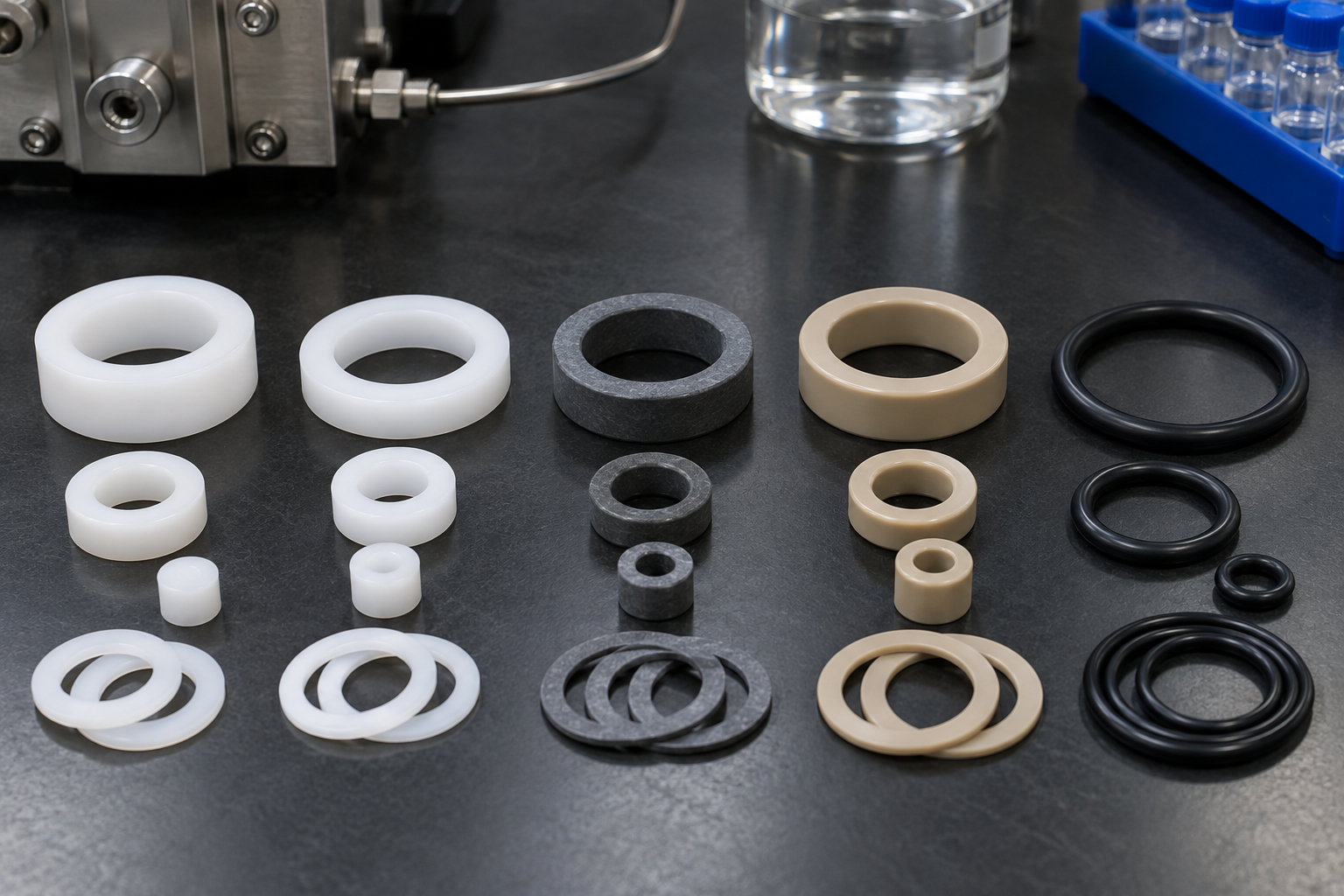
HPLC Seal Solvent Compatibility Guide
Compare PTFE, filled PTFE, UHMWPE, PEEK and elastomer sealing behavior across acetonitrile, methanol, THF, ketones, hexane, buffers and high-pH mobile phases.
HPLC and UHPLC pump seals work in direct contact with water, organic solvents, acids, bases, buffers and cleaning media while repeatedly sliding against a piston—often for millions of cycles.
A material that wears well in water and acetonitrile may degrade rapidly in THF, ketones or high-pH ammonium hydroxide. A material with broader chemical resistance may also create more abrasion, friction or piston wear.
HPLC solvent compatibility must be evaluated for the exact seal material, complete mobile-phase composition, pressure, temperature and pump design—not simply for the polymer family.
INITIAL SCREEN
HPLC Seal Materials at a Glance
Select a representative mobile-phase challenge to see the first material question to investigate. The result is a screening direction, not a substitute for the instrument manufacturer’s requirements.
Select the dominant solvent challenge
Routine ACN/water service often suits standard UHMWPE designs.
The complete formulation still matters when acids, bases, buffers or unusual gradient endpoints are added.
ACN percentage · water · additives · pressure · pump model
Preliminary screening only. Confirm the exact proprietary compound, piston pairing, pressure rating and OEM instructions before changing a seal.
| Material | Chemical resistance | Wear resistance | Friction | Typical role |
|---|---|---|---|---|
| UHMWPE | Very good for compatible media | Excellent | Low | Piston and plunger seals |
| Virgin PTFE | Exceptional | Moderate | Very low | Chemical-resistant seals |
| Filled PTFE | Excellent, filler-dependent | Improved | Low | Harsh-solvent pump seals |
| Polyethylene | Application-dependent | Good | Low | Specialized pump or wash seals |
| PEEK | Broad, not universal | Excellent | Higher | Structural, valve and support parts |
| FKM | Solvent-dependent | Good | Moderate | Static O-rings |
| EPDM | Good for aqueous systems | Good | Moderate | Water-based static sealing |
MULTIPLE DUTIES
Why Solvent Compatibility Matters in HPLC Pumps
A primary piston seal must contain the mobile phase, slide repeatedly against the piston, maintain contact pressure, resist swelling and produce minimal particles—all at the same time.
Contain pressure
Maintain leakage control across the complete gradient.
Survive motion
Withstand millions of reciprocating cycles.
Hold dimensions
Resist swelling, softening, shrinkage and creep.
Protect the system
Limit particles, piston wear and pressure variation.
ACETONITRILE
HPLC Seals and Acetonitrile
Acetonitrile is a core reversed-phase solvent and is commonly mixed with water, formic acid, TFA, ammonium salts or ammonium hydroxide. Standard reversed-phase seals are often designed for ACN/water, but additives can change the result.
The base—not necessarily the ACN—may shorten UHMWPE seal life.
- Give ACN and water percentages
- State pH and NH₄OH concentration
- List buffer additives
- Include normal and maximum pressure
METHANOL
HPLC Seals and Methanol
Many HPLC pump-seal materials are compatible with methanol-based mobile phases. The wider fluid path still needs review, especially with anhydrous methanol and acidic modifiers such as formic acid or TFA.
A seal can remain chemically stable while another part of the HPLC fluid path does not. Solvent review must therefore extend beyond the pump seal.
ISOPROPYL ALCOHOL
HPLC Seals and IPA
IPA is commonly used for cleaning, flushing, seal wash and normal-phase operation. It can bridge certain polar and nonpolar solvent systems and dissolve many organic residues.
Seal material, tubing compatibility, solvent miscibility and instrument-specific wash recommendations. A wash solvent must not precipitate residual mobile phase.
TETRAHYDROFURAN
HPLC Seals and THF
THF is one of the most important solvent challenges in HPLC pump-seal selection. It is used in specialized reversed-phase methods, polymer analysis, GPC/SEC and normal-phase chromatography.
THF can damage UHMWPE piston seals in specified pump configurations.
Actual risk depends on concentration, exposure duration and the proprietary seal compound.
Carbon-filled or engineered PTFE
Potentially broader chemistry, but pressure, abrasion and piston compatibility must be rechecked.
Do not treat a PTFE conversion as a simple drop-in material substitution without reviewing the complete pump design.
ACETONE · MEK · OTHERS
HPLC Seals and Ketones
Ketones can be aggressive toward some polyethylene-based pump seals. “Organic-solvent compatible” is not a universal rating and does not prove resistance to every ketone.
Check the OEM seal
Identify the exact material and approved solvent list.
Screen PTFE compounds
Match filler and chemistry to the ketone exposure.
Confirm pressure limits
Mechanical capability may change with a new compound.
Review the piston
Surface pairing influences abrasion and new-seal life.
NORMAL PHASE
HPLC Seals and Hexane
Hexane is common in normal-phase chromatography, GPC and nonpolar separations. Normal-phase operation can require a different primary seal, wash solvent and transition procedure than an aqueous reversed-phase system.
Changing directly between an aqueous system and a hexane-rich system can create miscibility issues even when the primary seal material is acceptable.
WATER + SALTS
Water and Buffer Solutions
Water itself is manageable for many seal materials, but aqueous mobile phases introduce buffer salts, biological growth, pH extremes and corrosion. “Water-compatible” does not automatically mean “buffer-compatible.”
pH EXTREMES
High-pH and Acidic Mobile Phases
Dilute additives are often tolerated, but the complete polymer and metal flow path must be checked.
Prolonged exposure can shorten the lifetime of certain UHMWPE seals in documented pump families.
Confirm compatibility with the piston, pump model and pressure rating. Use OEM-approved high-pH or filled-PTFE options where applicable.
MATERIAL BEHAVIOR
HPLC Seal Materials in Solvent Service
Broadest chemistry, very low friction
Excellent solvent compatibility, but virgin PTFE has creep, moderate wear resistance and lower mechanical strength. Pump seals usually need engineered geometry or fillers.
- THF and ketone screening
- Low friction
- Design-dependent pressure
Improved wear and dimensional stability
Carbon, graphite, glass or polymer fillers can improve wear, pressure resistance and creep behavior while changing abrasion, purity and solvent compatibility.
- Harsh-solvent duty
- Filler-specific behavior
- Piston-wear review
Excellent routine wear performance
Combines low friction, toughness and strong sealing performance in many reversed-phase applications, but selected designs have documented limits with THF, ketones and NH₄OH.
- Routine ACN/water
- Excellent wear
- Not universal
High-strength structural polymer
Often used in valve parts, support rings, fittings and specialized designs. It is stiffer and generally higher-friction than PTFE, so it is not automatically the best primary piston-seal material.
- High mechanical strength
- Valve and support roles
- Function-specific selection
Good with many oils, hydrocarbons and solvents; limits can include ketones, amines and polar media.
Strong candidate for water, aqueous buffers and dilute acids/bases; poor with many hydrocarbon solvents.
Broad resistance at high cost; most relevant to aggressive mixed-media static seals rather than routine pump pistons.
PRELIMINARY MATRIX
Quick HPLC Solvent Compatibility Screening Table
| Mobile phase / solvent | UHMWPE | PTFE / filled PTFE | Main concern |
|---|---|---|---|
| Water | Excellent | Buffers and microbial growth | |
| Methanol | Excellent | Check complete flow path | |
| Acetonitrile | Excellent | High-pH additives can change result | |
| ACN + NH₄OH | Often preferred for harsh duty | High pH | |
| IPA | Excellent | Wash-system compatibility | |
| THF | Often better candidate | Swelling or degradation | |
| Ketones | Often better candidate | Polymer attack | |
| Hexane | Good candidate | Normal-phase configuration | |
| Aqueous buffers | Generally suitable | Salt crystallization | |
| High-pH phase | Often stronger candidate | Seal lifetime | |
| Dilute acidic phase | Excellent | Complete flow-path compatibility |
Instrument manufacturer requirements take priority over this preliminary screening matrix.
SECONDARY FLUID
Seal-Wash Solvent Compatibility
Primary-seal compatibility and seal-wash compatibility are different questions. The wash must dissolve leaked mobile phase, remove buffer residue, remain system-compatible and avoid precipitation.
Aqueous wash + modest organic content
Follow the specific instrument manual and application requirements.
Compatible organic wash
Verify miscibility with the mobile phase and every wash-path component.
Nonvolatile buffer salts as seal wash. They can damage or clog wash-path components.
PRECIPITATION CONTROL
Why Seal Wash Must Never Precipitate the Mobile Phase
If an organic-rich wash contacts a water-soluble buffer with poor organic solubility, salt can precipitate directly where the piston and seal need a clean lubricated interface.
Where the mobile phase contains water-soluble salts, an aqueous-based seal wash can help prevent crystals from becoming friction agents.
FIELD DIAGNOSIS
Common Solvent-Related Seal Failure Symptoms
Swelling
Dimensions increase, friction rises and removal becomes difficult.
Solvent incompatibility · incorrect polymerSoftening
Seal deforms, extrudes or begins leaking under pressure.
Polymer attack · long exposureExcessive wear
Lip material disappears faster than the expected interval.
Wrong material · deposits · pressure · rough pistonSalt deposits
Crystals collect behind the primary seal and abrade the interface.
Buffer · ineffective wash · dry wash pathPressure instability
Flow repeatability falls or the pump struggles to hold pressure.
Worn seal · deformation · valves · airSolvent compatibility should be investigated together with piston condition, check valves, installation and the complete mechanical pump state.
COUPLED LOADS
How Solvent Compatibility Changes With Pressure
Immersion charts do not reproduce mechanical compression, reciprocating motion, high contact stress and extrusion gaps. Moderate swelling can become premature failure when pressure and dynamic wear are added.
Material may provide acceptable wear and extrusion control.
The same chemistry can produce unacceptable mechanical life.
SAME CHEMISTRY · GREATER STRESS
HPLC vs UHPLC Solvent Compatibility
UHPLC usually creates higher contact stress, stronger extrusion forces, tighter clearances and more demanding leakage limits. The most chemically resistant polymer is not automatically the longest-lasting UHPLC seal.
Chemical compatibility
Mechanical strength
Wear resistance
Low friction
Pressure stability
NEW METHOD WORKFLOW
How to Select an HPLC Seal for a New Mobile Phase
List every solvent
Give percentages and do not omit minor components.
Include the full gradient
Both 5% and 95% organic endpoints matter.
List pH modifiers
Formic acid, TFA, NH₄OH and other additives.
Define buffer salts
Chemical name and concentration.
Provide pressure
Normal and maximum operating values.
Identify the pump model
Seal, piston coating and limits are pump-specific.
Validate the seal wash
Dissolve residue without precipitating salts.
CUSTOM-SEAL INPUTS
Information Required for a Custom HPLC Seal
| Parameter | Information required | Engineering use |
|---|---|---|
| Instrument | Manufacturer and model | Identifies platform constraints |
| Pump model | Exact designation if available | Links seal and piston pairing |
| System | HPLC or UHPLC | Defines pressure class |
| Seal type | Piston, plunger, wash or valve | Defines movement and geometry |
| Mobile phase A | Complete formulation | Establishes chemistry endpoint |
| Mobile phase B | Complete formulation | Establishes chemistry endpoint |
| Gradient | Composition range | Captures every exposure state |
| Additives | Acids, bases and modifiers | Reveals hidden compatibility risks |
| Buffers | Type and concentration | Predicts crystallization risk |
| Pressure | Normal and maximum | Defines extrusion and contact load |
| Temperature | Normal and maximum | Controls aging rate |
| Piston | Material, coating and diameter | Controls mating-surface behavior |
| Current seal | Material if known | Provides the baseline design |
| Failure mode | Leakage, wear or swelling | Supports root-cause analysis |
| Service life | Current and target | Defines the improvement goal |
AVOIDABLE ERRORS
Common HPLC Seal Selection Mistakes
Selecting by solvent name alone
Water content, gradient endpoints, buffers and pH modifiers can change the result.
Assuming PTFE is always better
Broader chemistry may come with different abrasion, pressure and piston requirements.
Treating all polyethylene as identical
PE, UHMWPE and proprietary compounds have different behavior.
Ignoring the seal wash
An incompatible wash can destroy an otherwise suitable primary seal.
Ignoring buffer precipitation
The polymer can be compatible while salt crystals mechanically abrade it.
Changing material without checking the piston
The previous seal and piston pairing can influence the life of a replacement compound.
Looking only at chemical resistance
Pressure, wear, friction, extrusion and geometry are equally important.
PRACTICAL EXAMPLE
Troubleshooting a High-pH HILIC Seal Problem
Confirm pump model and current seal material.
Check whether UHMWPE is approved for this formulation.
Review ammonium-hydroxide concentration.
Inspect pistons for scratches or coating damage.
Verify that the seal-wash system is operating.
Screen an OEM-approved filled-PTFE option.
Reconfirm pressure rating after the material change.
This process is more reliable than simply ordering “a more chemical-resistant seal.”
FINAL DECISION
Engineering Summary
A successful HPLC or UHPLC pump seal must combine chemical resistance, low friction, wear resistance, pressure capability and dimensional stability in the actual pump.
List every component
Mobile phases, gradients, pH modifiers and buffers.
Define the load
Pressure, piston, speed, cycle count and temperature.
Control deposits
Dissolve residue and prevent salt crystallization.
Respect the pump design
Use approved material, geometry and piston pairing.
The best solution is the material and geometry that provide adequate solvent compatibility and reliable mechanical performance together.
QUICK ANSWERS
Frequently Asked Questions
Many reversed-phase seals are designed for ACN/water. High-pH additives such as ammonium hydroxide can change compatibility and shorten the life of some UHMWPE seals.
Many standard materials are suitable for methanol, but the complete flow path should be reviewed, especially with anhydrous methanol or acidic modifiers.
Some manufacturers specifically warn that THF can damage their UHMWPE piston seals. An approved PTFE-based alternative may be required for compatible pump configurations.
Not always. PTFE offers broad chemistry and low friction, while UHMWPE can offer excellent wear in routine duty. The pump, solvent and pressure determine the best balance.
Yes, depending on the pump and seal. Normal-phase systems may require dedicated materials, compatible wash solvents and careful solvent-transition procedures.
Yes. Dried salts can form abrasive deposits on the piston and accelerate wear even when the seal polymer is chemically compatible.
It depends on the pump. Some UHMWPE seals have documented concerns, while OEM-approved filled-PTFE alternatives may be available.
Follow the instrument manual. Aqueous wash with a modest organic component is common for many reversed-phase applications.
IPA or another compatible organic wash may be recommended, depending on the instrument and mobile-phase miscibility.
High pressure, piston damage, salt crystals, poor seal wash, installation, friction and geometry can all cause failure despite acceptable chemical resistance.
Need Help Selecting an HPLC Seal for Your Solvent System?
Send the full mobile-phase and pump specification. Walle Seals can review solvent compatibility, pressure, piston pairing and seal geometry together.
Discuss your application →- Instrument and pump model
- Complete mobile phases A and B
- Gradient, buffers and modifiers
- Normal and maximum pressure
- Piston material and diameter
- Current seal and failure symptoms
- Current and target service life
No responses yet