



How to Specify a Custom Industrial Seal: 10 Key Details to Send Your Manufacturer
Define the application. Bound the operating conditions. Send the drawing. A complete specification helps your manufacturer move from uncertainty to an application-specific quotation.
The drawing defines fit. Operating conditions define whether it works.
Ordering a custom industrial seal involves more than providing a diameter and choosing a rubber or plastic material. The seal must fit the equipment, withstand the operating environment, and perform reliably under the actual working conditions.
When important specifications are missing, manufacturers may need additional clarification before recommending a material, reviewing the design, or preparing a quotation. Incomplete information can also lead to unnecessary revisions, unsuitable prototypes, and avoidable delays.
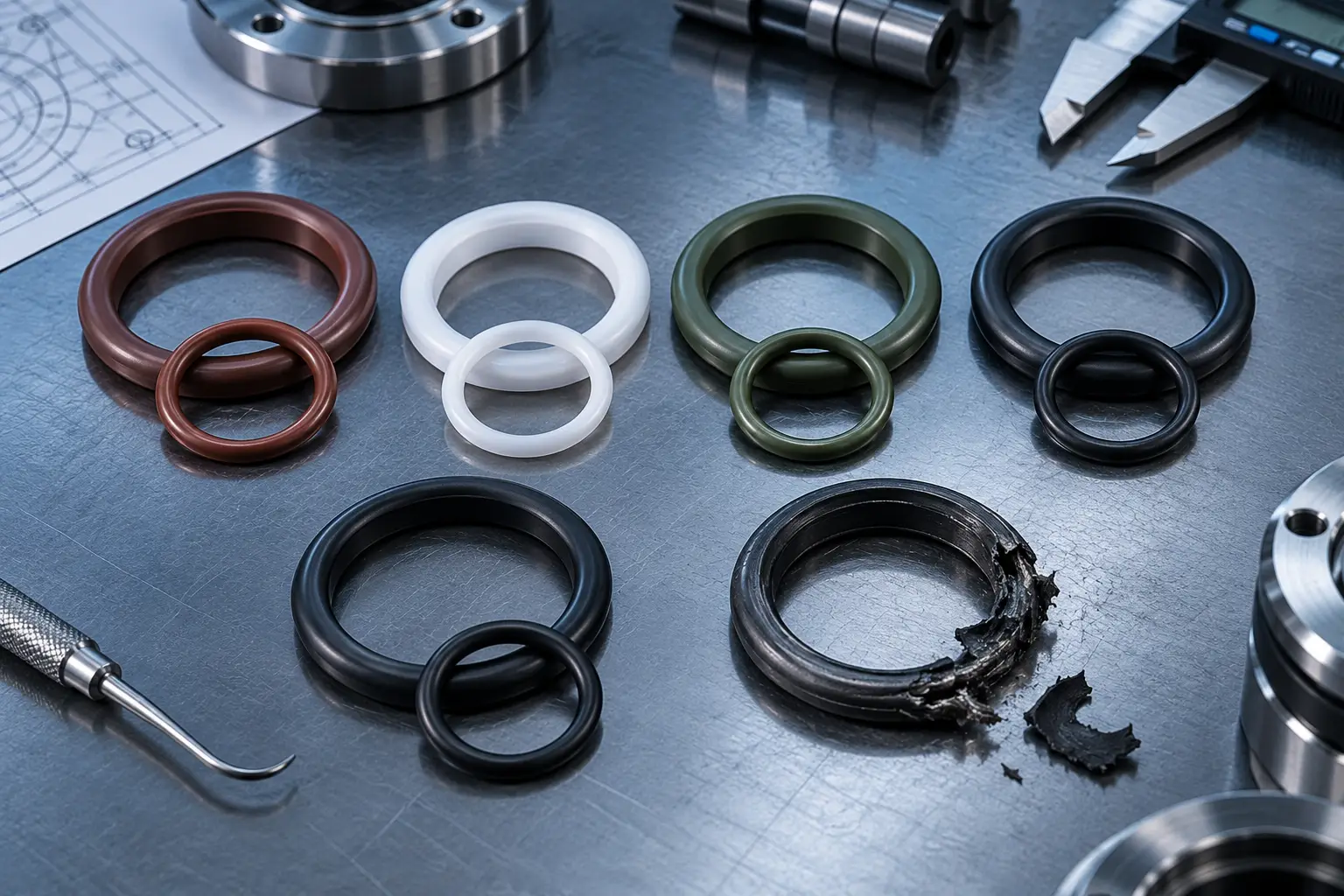
Whether you need a custom O-ring, PTFE seal, FFKM seal, spring-energized seal, hydraulic seal, or precision-molded rubber component, preparing the right information can make the development process more efficient.
In this guide, we explain the 10 key details to provide when requesting a custom industrial seal from a manufacturer.
A custom seal is specified by the environment it must survive—not by dimensions alone.
1. Describe the Application and Equipment
Start by explaining where the seal will be installed and what the equipment does.
A seal used in a hydraulic cylinder has different requirements from one used in a chemical pump, semiconductor processing system, analytical instrument, or adhesive dispensing machine.
Provide the following information:
- Equipment or machine type
- Industry and application
- Seal installation location
- Component being sealed, such as a shaft, piston, rod, valve, or housing
- Whether the seal is exposed to the process fluid or the external environment
- Any special operating or maintenance requirements
If possible, include a photograph of the assembly or a simplified drawing showing the seal’s location.
Understanding the application helps the manufacturer evaluate the relevant operating conditions before recommending a seal design.
2. Define the Sealing Function and Type of Movement
The required sealing function determines which seal designs should be considered.
Common applications include:
- Static sealing: The mating components remain stationary relative to each other.
- Reciprocating sealing: A rod or piston moves back and forth.
- Rotary sealing: A shaft rotates relative to the seal.
- Oscillating sealing: The components move through a limited angular range.
- Dynamic high-pressure sealing: The seal must maintain performance during movement and pressure changes.
Also explain whether the seal must prevent external leakage, retain internal pressure, separate two fluids, prevent contamination, or perform more than one function.
For dynamic applications, provide the movement direction, frequency, stroke length or rotational speed, and expected duty cycle.
A design suitable for static sealing may not be appropriate for continuous movement. Identifying the sealing function early helps narrow the available design options.
3. Identify the Operating Medium
The operating medium is one of the most important factors in industrial seal selection.
Specify the exact fluid, gas, chemical, lubricant, adhesive, or other substance that contacts the seal. When relevant, include the chemical concentration, mixture composition, and possible contaminants.
For example, a seal exposed to hydraulic oil may require a different material from one exposed to a strong cleaning agent, solvent mixture, hot adhesive, or reactive process gas.
Also consider conditions that may occur outside normal operation:
- Cleaning and flushing chemicals
- Startup and shutdown fluids
- Lubricants and additives
- Process residues
- Steam or hot-water exposure
- Changes in chemical concentration
Do not rely solely on a generic material name to establish compatibility. Performance depends on the specific compound, the medium, temperature, exposure time, and operating conditions.
If the chemical composition is confidential, provide as much relevant compatibility information as your organization can disclose.
4. Provide the Complete Temperature Range
A manufacturer’s material recommendation should consider more than the normal operating temperature.
Provide:
- Minimum operating temperature
- Normal operating temperature
- Maximum continuous temperature
- Short-term temperature peaks
- Heating and cooling cycles
- Cleaning or sterilization temperatures, if applicable
- Expected exposure duration at extreme temperatures
For example, a seal may operate at a moderate temperature for most of the production cycle but experience a much higher temperature during cleaning or process shutdown.
Repeated thermal cycling can also affect material properties, dimensional stability, and sealing force.
When evaluating a material, confirm that its specified temperature range applies to the actual compound and operating environment. Temperature capability alone does not guarantee compatibility with the process medium or suitability for a particular seal design.
5. Specify Operating Pressure and Pressure Changes
Pressure affects seal deformation, contact force, extrusion risk, and overall sealing reliability.
Provide the following details:
- Normal operating pressure
- Maximum operating pressure
- Pressure surges or transient peaks
- Vacuum conditions, if applicable
- Pressure direction
- Differential pressure across the seal
- Frequency of pressure changes
For higher-pressure applications, also identify the clearance between mating components. Excessive clearance can increase the risk of seal extrusion, particularly when pressure and temperature approach the limits of the selected design.
If the equipment operates through repeated pressurization and depressurization, explain the cycle frequency and any known pressure-related failure history.
These details help the manufacturer assess whether a conventional seal, a backup-ring arrangement, a spring-energized design, or another configuration should be considered.
6. Describe Movement, Speed, and Operating Cycles
Dynamic seals must accommodate movement while controlling leakage, friction, and wear.
For reciprocating applications, provide:
- Stroke length
- Linear speed
- Cycle frequency
- Direction of movement
- Expected operating hours
For rotary applications, provide:
- Shaft speed in RPM
- Shaft diameter
- Surface speed, if available
- Direction of rotation
- Continuous or intermittent operation
Also identify lubrication conditions, possible dry running, vibration, misalignment, and abrasive particles.
A seal that performs well under slow movement may not provide the same service life under high-speed operation. Likewise, a design suitable for lubricated service may require further evaluation if lubrication is limited.
The more accurately the motion profile is described, the easier it is to evaluate friction, wear, heat generation, and potential design limitations.
7. Supply Accurate Dimensions and the Seal-Groove Drawing
Seal + groove + mating hardware
Include dimensions, tolerances, clearance, finish and drawing revision—not only a worn sample.
Dimensions are essential for custom seal manufacturing, but the seal’s dimensions alone may not be sufficient.
Whenever possible, provide a dimensioned drawing of the seal and its installation groove.
Important information includes:
- Seal inside diameter and outside diameter
- Cross-sectional dimensions
- Groove width and depth
- Shaft or bore diameter
- Mating-component dimensions
- Dimensional tolerances
- Clearance between mating surfaces
- Surface finish and hardness requirements, where relevant
- Installation direction and available assembly space
For complex profiles, a 2D engineering drawing or 3D CAD model can help clarify the geometry.
If you only have an existing seal, provide clear photographs, measured dimensions, and information about its original installation. A worn or deformed seal may no longer represent its original dimensions accurately.
When available, include the original drawing number, part number, and revision level. These details can reduce ambiguity during design review and production.
8. Identify the Preferred Material and Any Compliance Requirements
If your engineering team has already specified a material, include the material name, grade, compound designation, hardness, or existing material specification.
Common material families used in industrial sealing include:
| Material | Typical selection considerations |
|---|---|
| NBR | Oil resistance and general industrial service |
| HNBR | Oil-related applications requiring improved heat and aging performance compared with standard NBR |
| FKM | Heat and chemical resistance in many demanding industrial applications |
| FFKM | Selected for applications requiring particularly broad chemical resistance and high-temperature capability |
| PTFE | Low friction and chemical resistance, with design considerations for creep and deformation |
| PEEK | Mechanical strength, wear resistance, and dimensional stability in demanding applications |
| EPDM | Weathering, ozone, and selected water-based or chemical applications |
These are general material characteristics, not universal compatibility guarantees. The suitability of any material depends on its grade, compound formulation, geometry, and working conditions.
If the seal is intended for food processing, pharmaceutical equipment, medical applications, or another regulated environment, specify the applicable requirements explicitly.
Depending on the application, you may need material declarations, traceability records, test reports, or other documentation. Confirm which requirements apply before finalizing the design.
If you are unsure which material to select, provide the operating conditions and ask the manufacturer to evaluate suitable options.
9. Share Previous Seal Failures and Existing Samples
If you are replacing a failed seal, explain what happened before requesting a new design.
Useful information includes:
- Leakage location
- Approximate service life before failure
- Cracking, hardening, swelling, or deformation
- Wear marks or surface damage
- Extrusion or tearing
- Changes in operating temperature or pressure
- Recent changes to the process medium
- Installation or maintenance issues
Photographs of the failed component can help identify visible damage patterns. If possible, include photographs of the mating surfaces and the installed seal location.
You can also provide the original sample, product code, drawing, or existing supplier specification.
However, a damaged seal should not automatically be treated as proof that the original design was incorrect. Failure can result from material incompatibility, incorrect dimensions, installation damage, contamination, excessive clearance, or operating conditions beyond the intended design limits.
Reviewing the failure history helps the manufacturer evaluate whether a replacement should retain the original design or consider a modification.
10. Confirm Quantity, Inspection, Testing, and Delivery Requirements
Before production, clarify the commercial and quality requirements.
Provide:
- Prototype or sample quantity
- Initial order quantity
- Estimated annual demand
- Expected repeat-order frequency
- Required dimensional inspection
- Material certification or test-report requirements
- Packaging and labeling specifications
- Batch traceability requirements
- Required delivery date and destination
If the seal will be used in critical equipment, determine whether prototype evaluation or application-specific testing is needed before approving production.
For repeat orders, confirm the drawing revision and material specification so that future orders can be matched to the approved requirements.
Lead time and cost depend on factors such as design complexity, material availability, tooling, inspection requirements, and order quantity. Supplying these details early helps the manufacturer assess the project more accurately.
A Practical Checklist for Requesting a Custom Industrial Seal
Before contacting a manufacturer, use the following checklist to organize your information.
| Information | What to provide |
|---|---|
| Application | Equipment type and seal location |
| Sealing function | Static, reciprocating, rotary, or oscillating |
| Operating medium | Fluid, gas, chemical, concentration, and contaminants |
| Temperature | Minimum, normal, maximum, and transient temperatures |
| Pressure | Normal, maximum, vacuum, surges, and pressure direction |
| Movement | Speed, stroke, RPM, and duty cycle |
| Dimensions | Seal drawing, groove geometry, tolerances, and mating dimensions |
| Material | Preferred grade, hardness, and compliance requirements |
| Failure history | Photographs, symptoms, service life, and previous specifications |
| Commercial requirements | Quantity, inspection, documentation, packaging, and delivery |
Not every application requires every detail at the beginning. If certain information is unavailable, identify it as unknown rather than guessing. The manufacturer can then clarify which measurements or tests are necessary to proceed.
Turn the ten details into an RFQ brief.
Check the information you have and add notes. Mark missing values as “Unknown”—do not guess.
This tool does not save or send your entries. Copy or download before leaving the page. The counter tracks preparation, not engineering approval.
How to Work With a Custom Seal Manufacturer
A structured development process generally begins with reviewing the application and operating conditions, followed by drawing and material evaluation.
Depending on the project, the process may include:
- Requirement review: Confirm the application, operating conditions, and performance objectives.
- Design evaluation: Review dimensions, groove geometry, and the proposed seal configuration.
- Material selection: Assess chemical compatibility, temperature, pressure, movement, and other relevant factors.
- Prototype evaluation: Manufacture and test samples when required.
- Production approval: Confirm the final specification, inspection criteria, and order requirements.
- Manufacturing and delivery: Produce the approved parts according to the agreed requirements.
The precise process depends on the design and application. For demanding service conditions, testing under representative operating conditions may be necessary before approving the final solution.
At WALLE, custom sealing solutions are available for non-standard dimensions, materials, colors, and structures based on customer drawings or samples.
Explore our Industrial Sealing Product Catalog to review available product categories, or contact our team through the WALLE quotation page to discuss your requirements.
Frequently Asked Questions
What information is needed to get a quote for a custom industrial seal?
Start with the application, operating medium, temperature, pressure, type of movement, dimensions, and required quantity. A drawing or sample is particularly useful for non-standard seals. Additional information may be needed depending on the design.
Can I order a custom seal without an engineering drawing?
Yes, a drawing is not always necessary to begin a discussion. You can provide a physical sample, photographs, available measurements, and details about the equipment. The manufacturer can review the information and identify what additional dimensions or drawings are needed.
How do I choose the right material for a custom seal?
Evaluate chemical compatibility, temperature, pressure, movement, wear, and applicable compliance requirements together. If you do not know the preferred material, provide the operating conditions so the manufacturer can assess suitable material options.
Can an existing seal be reproduced from a sample?
In many cases, an existing seal can be evaluated for reproduction. However, a sample alone may not reveal its original tolerances, material grade, manufacturing requirements, or intended operating limits. Providing the equipment details and failure history improves the evaluation.
What file formats can I send when requesting a custom seal?
WALLE’s online quotation form accepts PDF, DWG, DXF, ZIP, JPG, and PNG files, with a maximum file size of 10 MB. If your files exceed the limit or you have additional technical documents, contact the sales team to discuss an appropriate way to share them.
Request a Custom Industrial Seal Quote From WALLE
Looking for a manufacturer for custom O-rings, PTFE seals, FFKM seals, spring-energized seals, hydraulic seals, or precision-molded rubber components?
Share your drawing or sample along with the application details, operating medium, temperature, pressure, and required quantity.
The WALLE team can review your requirements, discuss suitable sealing materials and designs, and provide a quotation based on your application.
No responses yet