



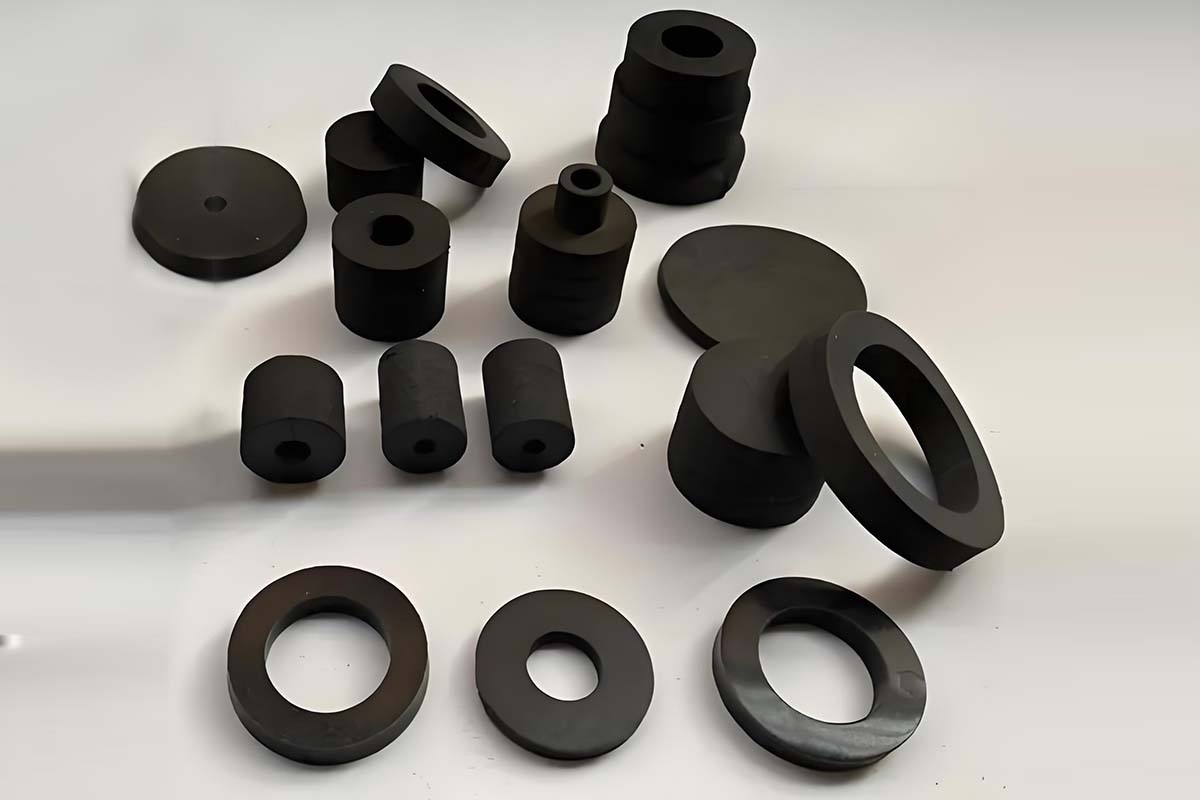
Natural rubber (NR) refers to an elastomer produced from latex harvested from rubber trees through processes such as coagulation and drying. Its main component is polyisoprene. It is the first general-purpose rubber to be put into industrial use worldwide, possessing excellent overall mechanical properties and unique self-reinforcing characteristics.
NR possesses very high tensile and tear strengths; the tensile strength of its unvulcanised rubber can reach 25–35 MPa, making it one of the highest-strength varieties among general-purpose rubbers. It also exhibits excellent elasticity and resilience, with outstanding elastic behaviour within the 0–100°C range, low dynamic heat generation, and good resistance to flex fatigue.
Natural rubber possesses outstanding abrasion resistance, second only to polyurethane rubber and butadiene rubber. It has a relatively high coefficient of friction, making it suitable for transmission or braking sealing components requiring high friction. Furthermore, NR has good processability and bonds easily with fillers, fibres and metal reinforcements, facilitating the manufacture of composite seals.
NR exhibits good resistance to dilute acids, dilute alkalis, alcohols and aqueous solutions, but is not resistant to concentrated strong acids, oils, fuels, non-polar solvents (such as benzene, toluene and petrol) or ozone. Prolonged exposure to air causes rapid cracking due to the effects of ozone and ultraviolet light, and it has poor weather resistance; therefore, protective waxes or blend modifications are usually required for outdoor applications.
The operating temperature range for natural rubber is generally -50°C to +80°C, though specially formulated grades can withstand short-term exposure up to +100°C. It exhibits excellent cold resistance, with a low-temperature brittleness threshold of approximately -50°C to -60°C; however, its physical properties deteriorate significantly at temperatures above +80°C, and it is not resistant to thermal-oxidative ageing, necessitating the use of anti-ageing agents.
Furthermore, NR possesses good electrical insulation properties, with a volume resistivity of approximately 10¹⁵ Ω·cm. It also offers good water resistance, airtightness and slip resistance. As the raw material is renewable and relatively low-cost, it is an important choice for economical sealing materials.
NR seals, i.e. sealing rings made from natural rubber, play a fundamental role in various dynamic and static sealing applications where oil resistance and outdoor exposure are not required, owing to their high mechanical strength, excellent elasticity and low-cost advantages.
Hydraulic and Pneumatic Seals: In low-pressure hydraulic systems, pneumatic tool seals, water pump gaskets and valve diaphragms, NR seals provide reliable static and reciprocating dynamic sealing thanks to their good resilience and resistance to compression set. However, NR must be avoided in hydraulic systems containing mineral oil; nitrile rubber should be used instead.
Automotive Manufacturing: NR material is widely used in automotive braking systems (with non-mineral oil-based brake fluids), cooling system pipe seals, shock absorber dust boots, chassis bushings and tyre valve stem seals. It exhibits excellent resistance to alcohol-based brake fluids (such as DOT 3 and DOT 4) and can withstand the vibrations and impact loads encountered during vehicle operation.
General Machinery and Industrial Products: In sealing gaskets for industrial pumps, valve seat seals for compressors, cushioning pads for textile machinery, and rubber springs for vibrating screens, NR seals, due to their high elasticity and resistance to flexural fatigue, can withstand prolonged cyclic deformation without suffering permanent deformation or tearing.
Water Supply, Drainage and Agricultural Irrigation: In pipe flange gaskets, tap seals, irrigation nozzle seals and auxiliary components for mechanical seals in water pumps, NR exhibits excellent resistance to clean water at ambient temperatures and is cost-effective. However, it should be noted that NR ages more rapidly in hot water systems exceeding 60°C; in such cases, EPDM rubber should be used instead.
Sports Equipment and Consumer Goods: In diving mask gaskets, cushioning pads for sports protective gear, toy valve seals, thermos flask lids, and non-implantable medical seals (such as blood pressure cuffs), NR’s softness and resilience provide excellent comfort and airtightness, whilst meeting relevant hygiene requirements.
Vibration Damping and Cushioning Seals: In rail pad sealing dust covers, lift buffer seals, precision instrument vibration-damping feet, and sealing protective sleeves for building seismic isolation bearings, NR seals not only provide sealing but also absorb vibrational energy; their low heat generation and high fatigue resistance help extend equipment lifespan.
Furthermore, NR sealing rings are widely used in mining conveyor equipment, printing machinery, agricultural machinery components and everyday hardware products. They are particularly suitable for applications where oil resistance is not a requirement, but where strength, elasticity and cost-effectiveness are paramount.In summary, due to their outstanding mechanical strength, high elasticity, excellent resistance to flexural fatigue and good water resistance, natural rubber materials and their NR seals hold an irreplaceable position in applications involving low-pressure water media, alcohol-based brake fluids, pneumatic systems and vibration-damping seals. At the same time, their cost-effectiveness makes them one of the most widely used general-purpose sealing materials.
Comments are closed