


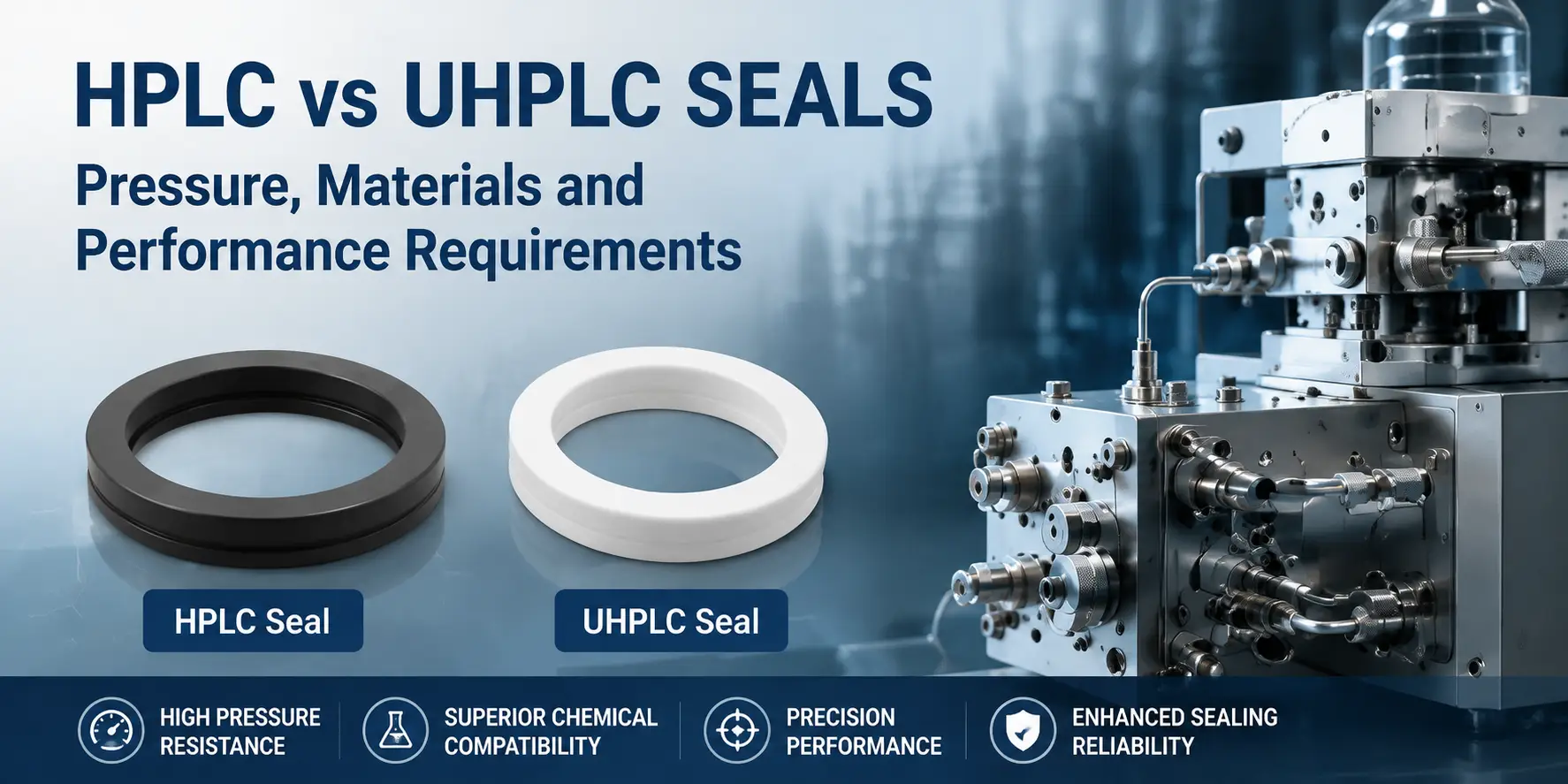
HPLC vs UHPLC Seals: Pressure, Materials and Performance Requirements
How pressure, solvent chemistry, dynamic wear and micron-level hardware clearances change the sealing strategy inside chromatography pumps.
High-performance liquid chromatography (HPLC) and ultra-high-performance liquid chromatography (UHPLC) systems rely on precision pump assemblies to deliver stable solvent flow under demanding pressure conditions.
Although they perform similar analytical functions, their sealing requirements are significantly different. The main difference is pressure.
Traditional HPLC systems typically operate at pressures up to several hundred bar, while UHPLC systems operate much higher—often approaching or exceeding 1,000 bar depending on the design.
A seal that performs reliably in an HPLC pump may not provide sufficient lifetime in a UHPLC system.
UHPLC does not simply require a stronger HPLC seal. It requires a solution designed specifically for higher pressure, tighter tolerances and more demanding performance conditions.
This guide compares HPLC and UHPLC seals based on pressure, materials, design requirements and performance expectations.
What Are HPLC and UHPLC Seals?
HPLC and UHPLC seals are precision components used primarily inside reciprocating pump systems. Their main function is to maintain solvent containment, pressure stability, flow accuracy, low leakage and long operating life.
A small sealing issue can cause pressure fluctuation, baseline instability, retention-time variation, poor analytical repeatability, solvent leakage and instrument downtime.
HPLC vs UHPLC: Basic System Comparison
| Parameter | HPLC | UHPLC |
|---|---|---|
| Full name | High Performance Liquid Chromatography | Ultra High Performance Liquid Chromatography |
| Typical pressure | Up to approximately 400–600 bar | Often 600–1,500+ bar depending on system |
| Particle size | Larger analytical particles | Smaller particles |
| Flow requirement | Moderate | High precision |
| Pump stress | High | Extremely high |
| Seal requirement | Chemical resistance and durability | High-pressure stability and wear resistance |
| Common seal challenge | Leakage and chemical swelling | Extrusion, friction and pressure cycling |
UHPLC achieves faster analysis and higher resolution by using smaller particle-size columns. Smaller particles create greater flow resistance, requiring higher pump pressure and directly increasing the sealing demand.
Why UHPLC Requires Different Seals
The pressure difference between HPLC and UHPLC changes the entire sealing environment.
Higher sealing force helps resist leakage but raises contact stress and friction. Pump seals may experience thousands or millions of cycles while repeatedly compressing, recovering, sliding and maintaining contact pressure.
HPLC Seal Requirements
Resist swelling, shrinkage, hardening and degradation in acetonitrile, methanol, water, isopropanol, THF, hexane, buffers and acid modifiers.
Limit motor load, heat, wear and pressure instability during continuous pump operation.
Enough contact to prevent leakage without excessive force that shortens seal life.
Maintain stable pressure, repeatability and useful maintenance intervals through extended laboratory operation.
Compression is a balance: too much increases friction and wear; too little allows leakage and pressure fluctuation.
UHPLC Seal Requirements
Higher extrusion resistance
At extreme pressure, material strength must resist extrusion, edge deformation and permanent damage.
Better wear resistance
Higher pressure increases contact stress between the seal and piston. Performance must remain stable over many cycles.
Controlled friction
UHPLC seals must balance low friction, high sealing force and long service life. More force improves leakage resistance but increases wear.
Pressure stability
Seal problems can create pressure ripple, flow variation, retention-time changes and reduced analytical accuracy.
Common HPLC and UHPLC Seal Materials
Several polymers are used for chromatography pump seals. The correct choice depends on solvent compatibility, pressure, temperature, pump design and required lifetime.
PTFE Seals
PTFE is one of the most common materials for HPLC and UHPLC seals.
Because pure PTFE can creep and has limited mechanical and wear strength, many chromatography seals use modified or filled PTFE compounds.
Filled PTFE for UHPLC Applications
Filled PTFE can improve wear resistance, compression resistance, dimensional stability and extrusion resistance. Possible fillers include carbon, glass and polymer-based modifiers.
- Wear resistance
- Dimensional stability
- Extrusion control
- Particle generation
- Extractables
- Solvent compatibility
A mechanically stronger PTFE compound is not always the best analytical choice. Filler chemistry and cleanliness must be evaluated with performance.
PEEK Seals
PEEK is a high-performance polymer used in chromatography systems where mechanical strength matters.
High mechanical strength, excellent pressure resistance, good wear resistance and dimensional stability.
High-pressure components, UHPLC applications, valve components and high-stress sealing locations.
Higher friction than PTFE and more limited compatibility in some solvents. Review solvent, temperature, pressure and required flexibility.
Elastomer Seals in HPLC Systems
Some chromatography systems use FKM, EPDM or special fluoroelastomer seals.
For aggressive solvent environments or very high-pressure UHPLC systems, PTFE-based solutions are often preferred.
HPLC vs UHPLC Seal Material Comparison
| Material | Chemical Resistance | Pressure Capability | Friction | Typical Use |
|---|---|---|---|---|
| PTFE | Excellent | Medium | Very low | HPLC/UHPLC pumps |
| Filled PTFE | Excellent | Higher | Low | High-cycle pumps |
| PEEK | Very good | Excellent | Medium | High-pressure components |
| FKM | Moderate | Medium | Medium | General sealing |
| EPDM | Limited with solvents | Medium | Medium | Water-based applications |
No single material is ideal for every chromatography system.
Why Seal Design Matters More Than Material Alone
Selecting a seal only by material is a common mistake. A successful chromatography seal also requires correct geometry, interference, spring-back, piston clearance and surface finish.
A rough piston can cause abrasion, leakage and early failure, while a surface that is too smooth may reduce lubrication retention. Too much clearance increases extrusion risk; too little increases friction. Even a high-performance material can fail if installed incorrectly.
Common HPLC and UHPLC Seal Failure Modes
Chemical incompatibility, wear, installation damage or loss of compression.
Seal deformation, internal leakage, air contamination or pump wear.
Excessive friction, poor finish, wrong material or high cycle frequency.
Solvent incompatibility can raise friction, motor load and leakage risk.
Excess pressure, large clearance or insufficient strength—especially in UHPLC.
Wear, compound selection or friction can affect detectors, columns and accuracy.
When Should You Upgrade to UHPLC-Grade Seals?
Consider an upgrade when operating pressure rises, seal lifetime falls, pressure stability deteriorates, solvent conditions become more aggressive, pump cycle frequency increases or maintenance cost grows.
Verify solvent compatibility, friction, hardware condition and required cycle life.
A more durable seal can reduce downtime, labor cost and instrument interruption when replacement intervals are already shortening.
How to Select the Right HPLC or UHPLC Seal
Provide the complete system and operating information before selecting a compound or profile.
- Pump manufacturer
- Model number
- Pump type
- Seal location
- Maximum pressure
- Normal pressure
- Flow rate
- Temperature
- All solvents
- Concentrations
- Buffer chemistry
- Cleaning fluids
- Piston material
- Piston diameter
- Stroke length
- Cycle frequency
- Required lifetime
- Leakage tolerance
- Particle limits
- OEM requirements
HPLC vs UHPLC Seal Selection Summary
Choose when
- Pressure is moderate
- Solvent conditions are controlled
- Standard lifetime is acceptable
Choose when
- Pressure is significantly higher
- Flow precision is critical
- Cycle frequency is high
- Extrusion resistance is required
- Analytical reliability is essential
The correct seal is not simply the hardest material. It is the material-and-design combination that delivers chemical compatibility, pressure stability, low friction, long cycle life and low contamination.
Frequently Asked Questions
Are HPLC and UHPLC seals the same?+
Not always. UHPLC systems operate at higher pressures and usually require improved extrusion resistance and wear performance.
What materials are used for HPLC seals?+
Common materials include PTFE, filled PTFE, PEEK and selected elastomers.
Why is PTFE popular for chromatography seals?+
PTFE provides excellent chemical resistance and very low friction.
Can an HPLC seal be used in UHPLC?+
Sometimes, but the seal must be verified for the higher pressure, extrusion, friction and cycle requirements.
Why do UHPLC seals wear faster?+
Higher pressure increases contact stress, friction and mechanical loading.
How long do HPLC pump seals last?+
Lifetime depends on solvent, pressure, flow rate, temperature, piston condition and operating cycles.
Can seal material affect chromatography results?+
Yes. Seal wear, particles or extractables can influence analytical reliability.
What causes UHPLC pump pressure fluctuation?+
Possible causes include seal wear, leakage, air bubbles, check-valve problems and pump-component damage.
Need a Custom HPLC or UHPLC Seal Solution?
Walle Seals manufactures precision HPLC pump seals, UHPLC piston seals, PTFE seals, filled PTFE components and custom polymer seals for chromatography equipment.
Our engineering team can help select the right solution based on solvent compatibility, pressure, pump design, temperature and lifetime expectations.
Send the pump model, seal dimensions, operating pressure, solvent information and current failure issue to begin the review.
No responses yet