

NBR vs FKM O-Rings: Complete Comparison Guide
Choosing between NBR and FKM O-rings is one of the most common challenges faced by engineers, maintenance professionals, and procurement managers.
Both materials are widely used in industrial sealing applications, but they have significant differences in temperature resistance, chemical compatibility, durability, and cost.
Selecting the wrong material can result in leakage, premature seal failure, increased maintenance costs, and unexpected downtime.
In this guide, we compare NBR and FKM O-rings in detail to help you determine which material is best for your application.
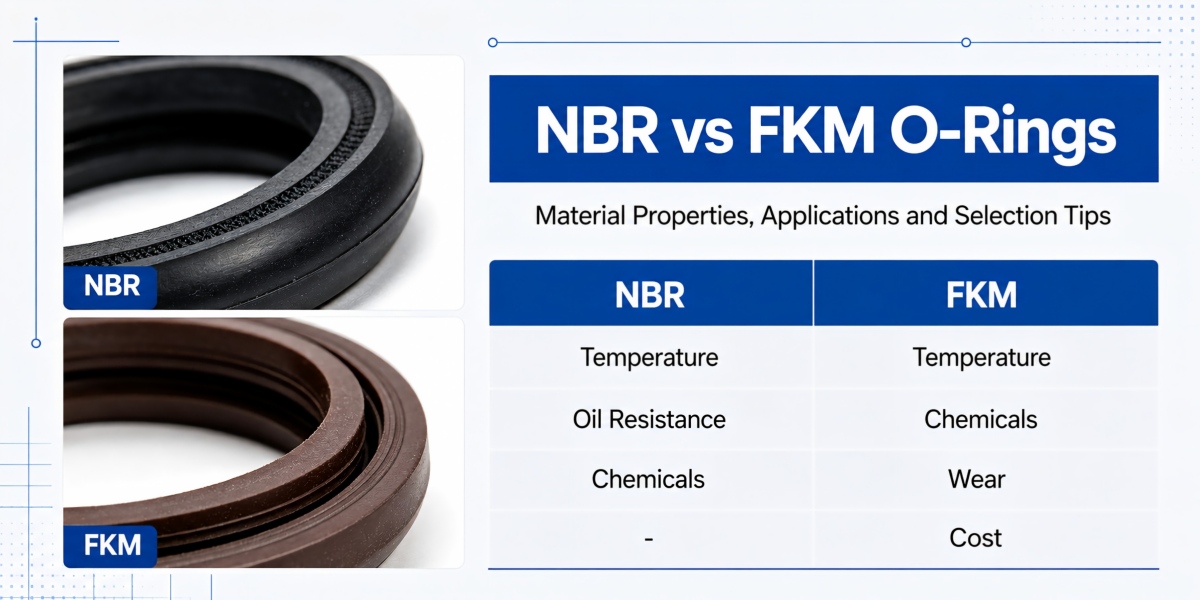
What Is an NBR O-Ring?
NBR (Nitrile Butadiene Rubber), also known as Buna-N, is one of the most widely used elastomers in the sealing industry.
NBR O-rings are known for:
- Excellent oil resistance
- Good mechanical properties
- Cost-effectiveness
- Wide availability
Because of their balance between performance and price, NBR seals are commonly used in hydraulic systems, pneumatic equipment, fuel systems, and industrial machinery.
Typical Applications of NBR O-Rings
- Hydraulic cylinders
- Pumps and valves
- Air compressors
- Fuel systems
- Agricultural machinery
- Construction equipment
What Is an FKM O-Ring?
FKM (Fluoroelastomer), often referred to by the well-known trade name Viton®, is a high-performance sealing material.
FKM O-rings offer:
- Excellent heat resistance
- Superior chemical resistance
- Outstanding aging resistance
- Long service life
These properties make FKM a preferred choice in demanding environments where NBR may not provide sufficient durability.
Typical Applications of FKM O-Rings
- Automotive engines
- Aerospace equipment
- Chemical processing systems
- Oil and gas equipment
- Semiconductor machinery
- High-temperature industrial equipment
NBR vs FKM: Key Differences
1. Temperature Resistance
Temperature capability is one of the biggest differences between these two materials.
| Material | Continuous Temperature Range |
|---|---|
| NBR | -40°C to 120°C |
| FKM | -20°C to 250°C |
NBR Performance
NBR performs well in moderate temperature environments.
However, prolonged exposure above 120°C can cause:
- Hardening
- Cracking
- Loss of elasticity
FKM Performance
FKM excels in high-temperature applications.
Benefits include:
- Better heat stability
- Lower compression set
- Longer service life
Winner: FKM
For applications above 120°C, FKM is generally the better choice.
2. Oil and Fuel Resistance
Both NBR and FKM offer excellent resistance to oils and fuels.
NBR Resistance
Suitable for:
- Mineral oils
- Hydraulic fluids
- Diesel fuel
- Lubricating oils
FKM Resistance
Suitable for:
- Gasoline
- Biodiesel
- Synthetic oils
- Aggressive fuels
- High-temperature fuel systems
Although both perform well, FKM maintains its properties better at elevated temperatures.
Winner: FKM
3. Chemical Resistance
Chemical compatibility is another major difference.
NBR Resistance
Good resistance to:
- Petroleum products
- Greases
- Hydraulic oils
Poor resistance to:
- Strong acids
- Ketones
- Ozone
- Chlorinated hydrocarbons
FKM Resistance
Excellent resistance to:
- Acids
- Solvents
- Aromatic hydrocarbons
- Aggressive chemicals
- Industrial cleaning agents
Winner: FKM
For chemical processing environments, FKM is typically the safer option.
4. Weather and Ozone Resistance
Outdoor exposure can significantly impact seal life.
NBR
NBR has limited resistance to:
- UV radiation
- Ozone
- Weathering
Long-term outdoor use may result in cracking and deterioration.
FKM
FKM offers:
- Excellent ozone resistance
- Better weather resistance
- Improved aging characteristics
Winner: FKM
5. Mechanical Strength
Mechanical performance includes:
- Tensile strength
- Tear resistance
- Abrasion resistance
NBR
NBR is known for:
- Excellent wear resistance
- Good tear strength
- Strong mechanical durability
FKM
FKM provides good mechanical properties but may not always match NBR in abrasion resistance.
Winner: NBR
For dynamic applications involving frequent movement, NBR can be advantageous.
6. Compression Set Resistance
Compression set refers to a seal’s inability to recover after prolonged compression.
NBR
At elevated temperatures, NBR may experience higher compression set.
FKM
FKM generally maintains elasticity better over time, especially under heat.
Benefits include:
- Longer sealing performance
- Reduced leakage risk
- Longer maintenance intervals
Winner: FKM
7. Service Life
Seal longevity affects maintenance costs and equipment reliability.
NBR Service Life
Suitable for standard industrial applications but may age faster in:
- High temperatures
- Outdoor environments
- Chemical exposure
FKM Service Life
Typically offers:
- Better aging resistance
- Longer replacement intervals
- Greater reliability in harsh conditions
Winner: FKM
8. Cost Comparison
Cost is often a critical purchasing factor.
NBR Cost
Advantages:
- Lower material cost
- Economical for high-volume production
- Widely available
FKM Cost
Advantages:
- Higher performance
- Longer lifespan
- Lower maintenance costs
However, initial purchase costs are significantly higher.
| Material | Relative Cost |
|---|---|
| NBR | Low |
| FKM | Medium to High |
Winner: NBR
For budget-sensitive projects, NBR is often preferred.
Side-by-Side Comparison Table
| Property | NBR | FKM |
|---|---|---|
| Oil Resistance | Excellent | Excellent |
| Fuel Resistance | Good | Excellent |
| Chemical Resistance | Good | Excellent |
| Temperature Resistance | Good | Excellent |
| Ozone Resistance | Fair | Excellent |
| Weather Resistance | Fair | Excellent |
| Abrasion Resistance | Excellent | Good |
| Service Life | Good | Excellent |
| Cost | Low | Higher |
When Should You Choose NBR O-Rings?
NBR is often the best option when:
- Cost is a major concern
- Operating temperatures remain below 120°C
- Exposure is primarily to oils and hydraulic fluids
- Applications involve frequent movement and wear
Typical Industries
- Hydraulics
- Pneumatics
- Agriculture
- Construction equipment
- General manufacturing
When Should You Choose FKM O-Rings?
FKM is recommended when:
- Temperatures exceed 120°C
- Chemical resistance is critical
- Long service life is required
- Equipment operates in harsh environments
Typical Industries
- Automotive
- Aerospace
- Oil and gas
- Chemical processing
- Semiconductor manufacturing
Common Mistakes When Choosing Between NBR and FKM
Choosing NBR for High Temperatures
One of the most common causes of seal failure is using NBR in applications exceeding its temperature limit.
Overpaying for FKM in Standard Applications
Many applications do not require the advanced performance of FKM.
Using FKM where NBR performs adequately may unnecessarily increase costs.
Ignoring Chemical Compatibility
Always verify compatibility with process fluids before selecting a material.
Conclusion
Both NBR and FKM are excellent sealing materials, but they serve different purposes.
Choose NBR when you need:
- Cost-effective sealing
- Excellent oil resistance
- Strong mechanical durability
Choose FKM when you need:
- High-temperature performance
- Superior chemical resistance
- Longer service life
Understanding the operating environment, temperature range, and chemical exposure is the key to selecting the right O-ring material and maximizing sealing performance.
Frequently Asked Questions
Is FKM always better than NBR?
Not necessarily. FKM offers superior temperature and chemical resistance, but NBR is often the more economical choice for standard oil-based applications.
Can NBR replace FKM?
Only if the application temperature and chemical exposure remain within NBR’s operating limits.
How much more expensive is FKM than NBR?
FKM can cost several times more than NBR depending on material grade, size, and production volume.
Which material lasts longer?
In harsh environments involving heat, chemicals, or ozone exposure, FKM generally provides a longer service life.
CTA
Need Help Choosing Between NBR and FKM O-Rings?
Our sealing experts can help you select the most cost-effective material for your application. We manufacture custom O-rings in NBR, FKM, EPDM, Silicone, and FFKM compounds for industries worldwide.
Contact us today for technical support, free samples, and competitive quotations.
No responses yet