



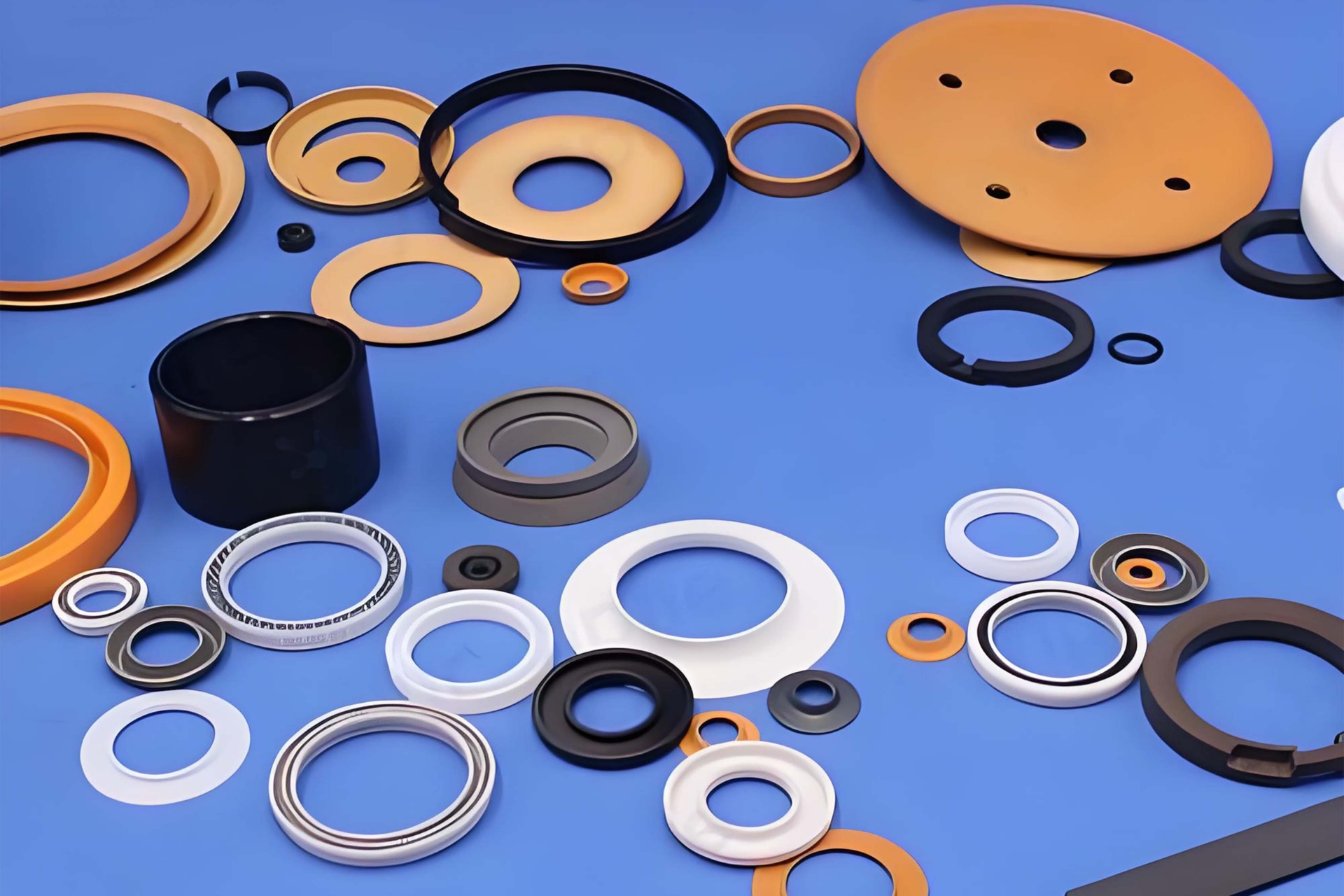
PTFE filled Bronze, Carbon, Ceramic, Carbon Fiber, Ekonol, Glass Fiber, Glass Beads, Graphite, Mica, MoS2, Polyimide
Filled PTFE (Filled Polytetrafluoroethylene) is a high-performance composite material made by using pure PTFE as a matrix and adding modifying fillers such as fiberglass, carbon fiber, graphite, molybdenum disulfide, and bronze powder through processes including mixing, compression molding, and sintering. While pure PTFE offers excellent chemical resistance and an extremely low coefficient of friction, it suffers from poor wear resistance, high creep, and a high thermal expansion coefficient. Filling modification significantly improves the material’s mechanical strength, thermal conductivity, creep resistance, and wear resistance.
Filled PTFE has excellent chemical inertness, resisting almost all strong acids, strong alkalis, organic solvents, and oxidants – only molten alkali metals and high-temperature fluorine gas affect it. Its long-term service temperature ranges from -200°C to 260°C, and it maintains a low coefficient of friction and self-lubricating properties even at high temperatures.
By selecting different fillers, targeted performance optimization can be achieved: fiberglass improves compressive strength and wear resistance; carbon fiber enhances thermal conductivity, creep resistance, and fatigue resistance; graphite and molybdenum disulfide reduce the friction coefficient and improve surface lubricity; bronze powder significantly increases load-bearing capacity and dimensional stability.
In addition, filled PTFE has excellent aging resistance, UV resistance, and radiation resistance. Specific grades comply with FDA or USP Class VI standards, making them suitable for food or medical contact applications. Its electrical insulation is generally good under normal conditions, while conductive or anti-static types (e.g., those with carbon fiber) can meet specific electronic equipment requirements.
Modified PTFE seals, i.e., seals made from filled PTFE materials, combine the chemical resistance of PTFE with the enhanced properties of fillers. They have become a critical sealing solution in harsh operating conditions.
Chemical & Petrochemical Industry: In highly corrosive media (e.g., sulfuric acid, hydrochloric acid, organic solvents), high-temperature or high-pressure fluid transfer systems, Modified PTFE seals are used in reactors, pipeline flanges, valves, pumps, and compressors. Their chemical corrosion resistance and creep resistance ensure long-term reliable sealing, significantly reducing leakage risks.
Hydraulic & Pneumatic Systems: In oil-free lubrication or media-contaminated environments, such as hydraulic cylinder piston seals and pneumatic cylinder rod seals, Modified PTFE seals filled with carbon fiber or graphite provide a very low friction coefficient and self-lubrication, preventing “stick-slip” phenomenon and extending equipment life.
Food & Pharmaceutical Industries: Modified PTFE seals with FDA-compliant fiberglass or special fillers are used in filling valves, homogenizers, sterilizers, and similar equipment. Their resistance to high-temperature steam and cleaning agents, as well as their non-adsorbent and non-shedding properties, ensure hygiene and safety during production.
Semiconductor & Electronics Industry: In ultra-clean chemical processing, high-temperature etching, and wet cleaning equipment, Modified PTFE seals (especially anti-static types) are used in wafer baths and chemical delivery lines. Their extremely low metal ion extraction, plasma resistance, and UV resistance meet the stringent requirements of high-purity processes.
General Machinery & Precision Instruments: In high-speed rotary shaft seals, reciprocating motion seals, vacuum seals, and low-temperature sealing applications, such as rotary unions, textile machinery, valve actuators, and analytical instruments, Modified PTFE seals provide precise sealing compensation thanks to their stable dimensions and low wear characteristics.
New Energy & Aerospace: In hydrogen fuel cell systems, aviation fuel lines, and rocket propellant valves, Modified PTFE seals withstand extreme temperature changes, high-pressure hydrogen embrittlement, and strong oxidizing environments, making them core sealing components.
Furthermore, Modified PTFE seals are widely used in automotive engine peripheral components, air conditioning refrigeration compressors, brake systems, water treatment membrane housing end caps, cable connector protection, and many other fields. They are an effective solution for sealing challenges involving high temperature, corrosion, difficult lubrication, and long service life.
In summary, through rational modification design, filled PTFE materials and their seals fully leverage the chemical advantages of PTFE while compensating for its mechanical shortcomings. They exhibit excellent sealing reliability under extreme chemical, thermal, and mechanical conditions, providing an indispensable sealing guarantee for modern process industries, advanced manufacturing, and special environment equipment.
Comments are closed