


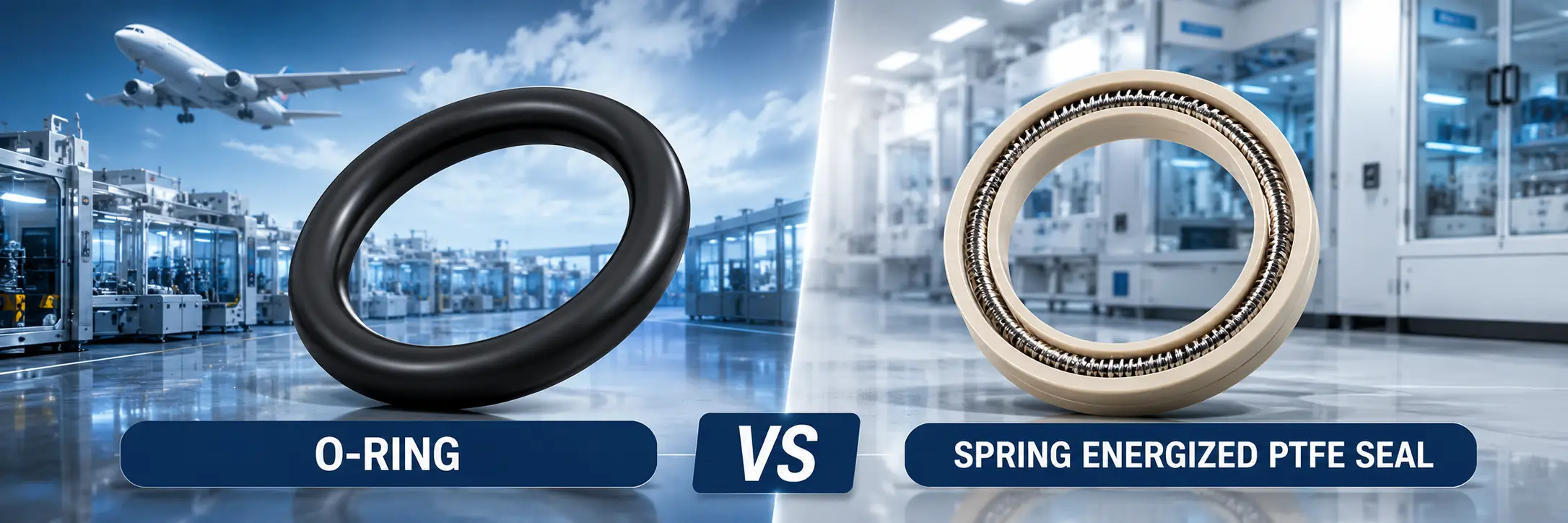
Spring Energized PTFE Seals vs O-Rings: When Should You Upgrade?
O-rings are affordable and reliable for standard duty — but extreme temperatures, aggressive chemicals, high vacuum and dynamic motion often push elastomers beyond their limits. Learn when spring energized PTFE seals deliver measurable performance gains.
O-rings are one of the most widely used sealing solutions in industrial equipment. They are affordable, easy to install, available in standard sizes and reliable in many applications.
However, as operating conditions become more demanding, engineers often face limitations with traditional elastomer O-rings. Extreme temperatures, aggressive chemicals, high vacuum, low friction requirements and dynamic movement can push conventional O-ring designs beyond their practical operating range.
This is where spring energized PTFE seals become a preferred alternative. A spring energized PTFE seal combines a chemically resistant polymer jacket with a metallic spring energizer to provide continuous sealing force.
Unlike an O-ring, which depends mainly on elastomer elasticity, a spring energized seal uses mechanical spring force to maintain contact with the sealing surface.
The key question is not:
“Are spring energized seals better than O-rings?”
The better engineering question is:
“When does my application require the performance advantages of a spring energized PTFE seal?”
The right question is not “Are spring energized seals better than O-rings?” — it’s “When does my application require the performance advantages of a spring energized PTFE seal?”
This article explains the differences between spring energized PTFE seals and O-rings and helps engineers determine when upgrading makes technical and economic sense.
What Is a Spring Energized PTFE Seal?
A spring energized PTFE seal consists of two primary components:
- A PTFE or engineered polymer sealing jacket
- A metallic spring energizer
The polymer jacket provides:
- Chemical resistance
- Low friction
- Wear resistance
- Temperature capability
- Media compatibility
The spring provides:
- Initial sealing force
- Continuous contact pressure
- Wear compensation
- Reliable sealing at low pressure or vacuum
Because PTFE has excellent chemical resistance but limited elastic recovery compared with rubber materials, the spring compensates for PTFE’s lack of natural resilience.
Spring energized seals are commonly used in:
- Semiconductor equipment
- Vacuum systems
- Aerospace systems
- Chemical processing
- Hydraulic equipment
- Cryogenic applications
- Medical equipment
- High-performance valves
How Do Traditional O-Rings Work?
An O-ring is an elastomer sealing element with a circular cross-section.
Common O-ring materials include:
- NBR
- EPDM
- FKM
- FFKM
- Silicone
- HNBR
O-rings seal through two mechanisms:
1. Compression squeeze
During installation, the O-ring is compressed inside the groove. The elastomer attempts to recover its original shape, creating sealing force against the hardware surfaces.
2. Pressure energization
When system pressure increases, pressure pushes the O-ring toward the lower-pressure side of the groove. This increases contact pressure and improves sealing.
O-rings perform extremely well when:
- Temperature is moderate
- Chemicals are compatible
- Pressure is within limits
- Movement is limited
- Friction requirements are not critical
However, their performance depends heavily on maintaining elastomer elasticity.
Spring Energized PTFE Seal vs O-Ring: Basic Comparison
| Feature | O-Ring | Spring Energized PTFE Seal |
|---|---|---|
| Sealing material | Elastomer rubber | PTFE/polymer jacket |
| Energizing method | Elastomer elasticity | Metal spring force |
| Chemical resistance | Material dependent | Excellent with PTFE |
| Temperature capability | Limited by elastomer | Very wide |
| Vacuum performance | Application dependent | Excellent |
| Friction | Medium | Very low |
| Dry running | Limited | Excellent |
| Compression set | Possible | Minimal |
| Dynamic performance | Moderate | Excellent |
| Initial cost | Low | Higher |
| Customization | Limited | Highly customizable |
Spring energized seals are not designed to replace every O-ring application. They are designed for applications where conventional sealing technology reaches its limits.
Upgrade When Temperature Exceeds O-Ring Capability
Temperature is one of the most common reasons engineers move from O-rings to spring energized PTFE seals.
Elastomers experience changes in mechanical properties when exposed to extreme temperatures.
At high temperatures:
- Rubber can soften
- Compression set increases
- Elastic recovery decreases
- Chemical degradation accelerates
At low temperatures:
- Rubber becomes stiff
- Flexibility decreases
- Sealing force drops
- Leakage can occur during startup
Spring energized PTFE seals can maintain sealing performance across much wider temperature ranges because:
- PTFE remains stable at high temperatures
- The spring maintains contact force
- Thermal cycling has less effect on sealing force
Typical applications include:
- Cryogenic valves
- Vacuum chambers
- High-temperature processing equipment
- Aerospace systems
Upgrade When Chemical Compatibility Becomes a Problem
Chemical attack is another major reason to consider spring energized PTFE seals.
Even high-performance elastomers such as FKM and FFKM have chemical limitations.
Chemical exposure can cause:
- Swelling
- Hardening
- Softening
- Cracking
- Loss of mechanical properties
PTFE provides excellent resistance against a wide range of:
- Acids
- Solvents
- Fuels
- Aggressive chemicals
- Process fluids
Applications that often benefit from PTFE spring energized seals include:
- Chemical pumps
- Semiconductor process equipment
- Laboratory instruments
- Pharmaceutical systems
- Aggressive fluid handling systems
However, chemical compatibility must always consider:
- PTFE compound
- Spring material
- Temperature
- Pressure
- Exposure time
The polymer may survive the chemical while the metal spring requires a corrosion-resistant alloy.
Upgrade for Vacuum Applications
Vacuum systems create unique sealing challenges.
Traditional O-rings rely heavily on elastomer recovery to maintain sealing force. Over time, elastomers may experience:
- Compression set
- Material relaxation
- Loss of contact pressure
- Increased leakage
Spring energized PTFE seals maintain sealing force through the metal spring.
This makes them suitable for:
- Semiconductor vacuum chambers
- Vacuum valves
- Scientific instruments
- Analytical equipment
- Aerospace vacuum systems
Additional advantages include:
- Low outgassing
- Low permeability
- Stable performance during thermal cycling
For ultra-clean vacuum applications, seal material selection must also consider:
- Particle generation
- Extractables
- Trace metals
- Cleaning requirements
Upgrade When Low Friction Is Required
Dynamic applications often expose the limitations of elastomer O-rings.
Common problems include:
- High breakaway force
- Stick-slip movement
- Friction variation
- Heat generation
- Wear
Spring energized PTFE seals provide:
- Lower coefficient of friction
- Smooth movement
- Reduced actuator force
- Better wear resistance
They are commonly used in:
- Precision actuators
- Robotics
- Semiconductor equipment
- Hydraulic cylinders
- Aerospace mechanisms
For high-cycle applications, PTFE compounds can also be modified with fillers to improve wear resistance.
Upgrade for High-Speed or Dynamic Motion
O-rings can work well in slow-moving applications. However, dynamic motion introduces additional challenges:
- Friction
- Wear
- Heat buildup
- Surface damage
- Extrusion
Spring energized PTFE seals are often selected for:
- Reciprocating motion
- Rotary motion
- Oscillating systems
The spring maintains consistent sealing contact even as:
- The seal wears
- Temperature changes
- Hardware expands or contracts
However, successful dynamic sealing requires proper design:
- Correct spring load
- Suitable PTFE compound
- Proper surface finish
- Correct lubrication strategy
Upgrade When Pressure and Temperature Combine
Pressure alone does not always require a spring energized seal. Many O-rings successfully handle high pressure.
The challenge appears when pressure combines with:
- High temperature
- Large extrusion gaps
- Chemical exposure
- Pressure cycling
High temperature reduces elastomer strength and increases extrusion risk.
Spring energized PTFE seals offer:
- Higher modulus materials
- Better extrusion resistance
- Stable sealing force
Typical applications include:
- High-pressure valves
- Hydraulic systems
- Chemical reactors
- Aerospace equipment
Upgrade for Cryogenic Applications
Cryogenic environments are among the clearest cases where spring energized PTFE seals outperform elastomer O-rings.
At very low temperatures, elastomers can:
- Become glass-like
- Lose flexibility
- Fail to recover after compression
Spring energized PTFE seals continue to function because:
- PTFE remains suitable for extremely low temperatures
- The metal spring maintains contact pressure
Common applications:
- Liquid nitrogen systems
- LNG equipment
- Space systems
- Cryogenic pumps
- Oxygen systems
Cryogenic sealing requires careful selection of:
- PTFE grade
- Spring alloy
- Hardware contraction
- Installation design
When Should You Keep Using O-Rings?
Spring energized seals provide excellent performance, but they are not always the best choice.
O-rings remain the preferred solution when:
- Moderate operating conditions
Normal industrial temperatures, compatible fluids and standard pressure ranges - Cost is the primary factor
O-rings are significantly more economical - Large quantities are required
Standard O-rings are easy to source and inventory - Simple static sealing
Many flange and housing applications do not require advanced sealing technology - Limited performance requirements
If the application is already reliable, upgrading may not provide meaningful value
When Should You Upgrade to Spring Energized PTFE Seals?
Consider upgrading when you experience:
- Repeated O-ring failures
Frequent leakage, short maintenance intervals, swelling, cracking or compression set - Extreme temperature
Cryogenic service or high-temperature processing - Aggressive chemicals
Strong solvents, acids or reactive gases - Vacuum leakage
Longer pump-down times or base pressure instability - Excessive friction
High actuator force or stick-slip movement - Strict contamination requirements
Semiconductor processing, medical equipment or laboratory systems
Cost Comparison: Is the Upgrade Worth It?
Low visible purchase cost
The biggest disadvantage of spring energized PTFE seals is cost.
A spring energized seal usually costs more than a standard O-ring because it involves:
- Precision machining
- Custom profiles
- Metal springs
- Specialized materials
However, purchase price is only one part of sealing cost. The total cost should include:
- Replacement frequency
- Equipment downtime
- Maintenance labor
- Production losses
- Contamination events
- System reliability
A more expensive seal can reduce total operating cost if it:
- Extends maintenance intervals
- Prevents leakage failures
- Improves equipment uptime
- Reduces contamination risk
For critical equipment, reliability often has a greater economic impact than the seal unit price.
Spring Energized PTFE Seal Selection Checklist
| Category | Details to evaluate |
|---|---|
| Operating conditions | Temperature range, pressure range, vacuum level, thermal cycling |
| Media | Chemicals, gases, solvents, cleaning agents |
| Motion | Static, reciprocating, rotary |
| Hardware | Groove design, surface finish, clearance, shaft hardness |
| Cleanliness | Particle requirements, outgassing limits, trace metal requirements |
| Service requirements | Maintenance interval, cycle life, reliability target |
| Current seal | Existing O-ring material, failure mode, replacement frequency |
| Quantity | Prototype volume and annual demand |
Common Mistakes When Upgrading From O-Rings
Selecting PTFE without considering the spring
The spring material may limit chemical or temperature performance.
Using the old O-ring groove
Spring energized seals often require different gland designs.
Choosing excessive spring force
Higher spring force can increase friction, wear and heat generation.
Ignoring surface finish
PTFE seals require proper hardware surfaces for optimal performance and wear life.
Assuming all PTFE materials are identical
Filled and unfilled PTFE compounds have different performance characteristics.
Final Decision: O-Ring or Spring Energized PTFE Seal?
The decision can be summarized:
Choose an O-ring when:
- Conditions are moderate
- Cost is critical
- Standard sealing performance is sufficient
Upgrade to a spring energized PTFE seal when:
- Temperature becomes extreme
- Chemicals are aggressive
- Vacuum performance matters
- Friction must be minimized
- Dynamic reliability is critical
- Contamination control is required
A spring energized seal is not simply a more expensive O-ring replacement. It is a different sealing technology designed for applications where traditional elastomer sealing reaches its practical limits.
Frequently Asked Questions
Are spring energized seals better than O-rings?+
Not always. They are better for extreme conditions such as vacuum, cryogenic temperatures, aggressive chemicals and demanding dynamic applications.
Why are spring energized seals made from PTFE?+
PTFE provides excellent chemical resistance, low friction and wide temperature capability.
Can spring energized seals replace FFKM O-rings?+
In some applications, yes. They may provide better friction, vacuum or chemical performance depending on conditions.
Are spring energized seals expensive?+
Yes, they typically cost more than O-rings, but they can reduce total operating cost by improving reliability.
Can spring energized seals be used in semiconductor equipment?+
Yes. They are widely used where low particles, low outgassing and chemical resistance are required.
Do spring energized seals work without pressure?+
Yes. The internal spring provides sealing force even at zero pressure.
Need Help Selecting a Spring Energized PTFE Seal?
Walle Seals provides custom spring energized PTFE seals for demanding applications including:
- Semiconductor equipment
- Vacuum systems
- Luft- und Raumfahrt
- Chemical processing
- High-pressure systems
- Cryogenic equipment
Our engineering team can help select:
- PTFE material
- Spring type
- Spring alloy
- Seal profile
- Groove design
Send your application information:
- Operating temperature
- Pressure or vacuum level
- Media compatibility requirements
- Motion type
- Seal dimensions
- Current O-ring failure issues
We can help determine whether upgrading from an O-ring to a spring energized PTFE seal is the right solution.
No responses yet