




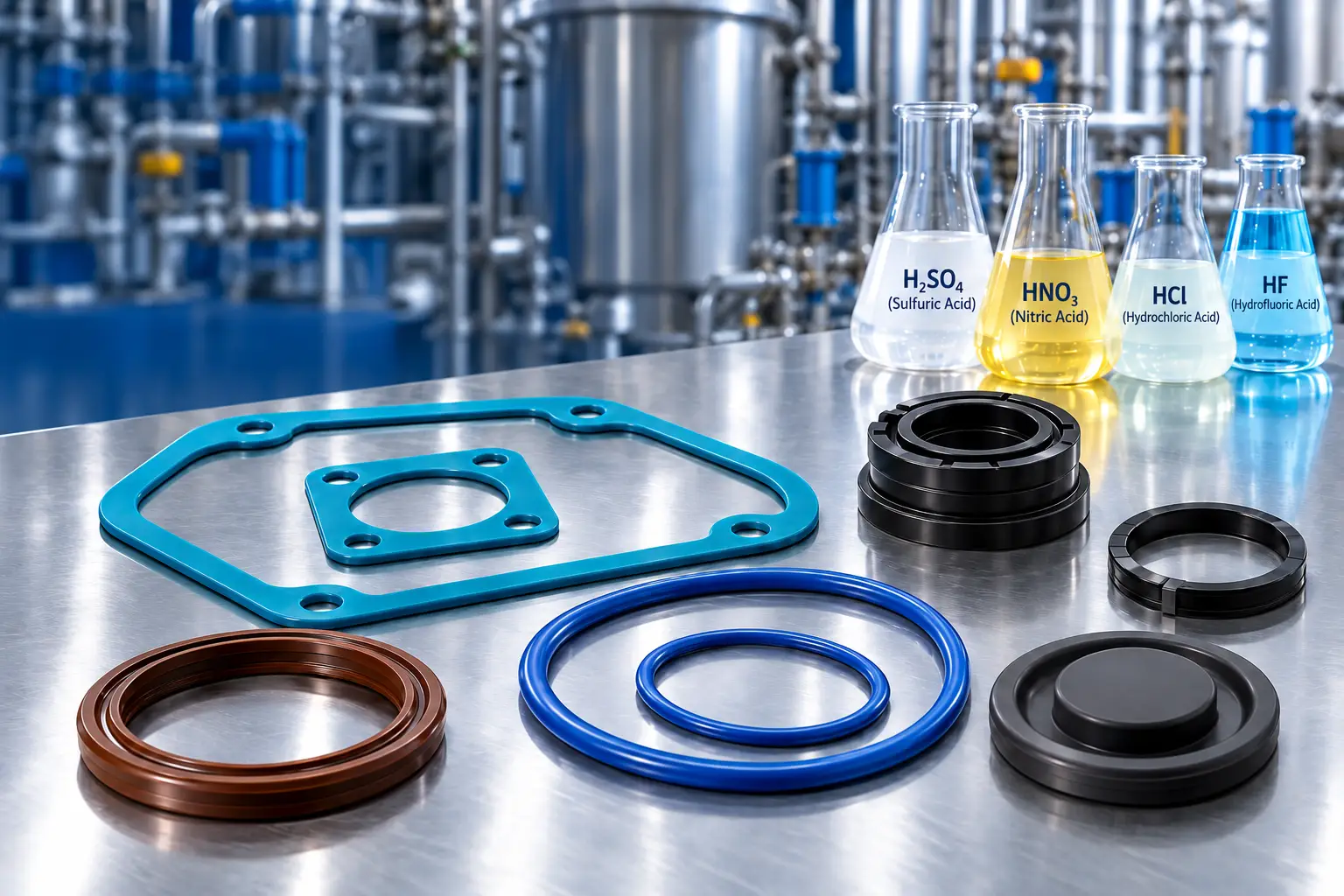
FFKM Seals for Strong Acids: Chemical Resistance and Selection Guide
A practical engineering guide to sulfuric, nitric, hydrochloric, phosphoric, hydrofluoric and mixed-acid service—where concentration, temperature and compound formulation decide the result.
Strong acids create some of the most demanding sealing environments in chemical processing. An O-ring or gasket may face high concentration, elevated temperature, oxidation, pressure, vacuum, mixed chemistry and repeated thermal cycles at the same time.
FFKM combines broad chemical resistance with the elastic recovery needed for O-rings, gaskets and custom molded seals. That combination makes it a strong candidate when NBR, EPDM or standard FKM cannot deliver sufficient service life.
“FFKM” alone does not guarantee compatibility. The exact compound, acid concentration, temperature, exposure time and process conditions must be evaluated together.
INITIAL SCREEN
FFKM Strong-Acid Compatibility at a Glance
This interactive screen highlights the dominant risk for each acid family. It is a starting point only; final approval requires the exact compound and operating window.
Select the process acid
Concentration and high temperature control the selection.
Concentrated sulfuric acid at elevated temperature is far more severe than dilute room-temperature service.
Concentration · water content · temperature · exposure time · cleaning media
Screening guidance only. The base polymer, cure system, fillers, seal geometry and complete process stream can all change the result.
| Acid | General FFKM potential | Main selection risk |
|---|---|---|
| Sulfuric acid | Concentration and high temperature | |
| Nitric acid | Strong oxidation | |
| Hydrochloric acid | Concentration and process mixture | |
| Phosphoric acid | Temperature and additives | |
| Hydrofluoric acid | Fillers, purity and concentration | |
| Mixed acids | Combined chemistry and oxidation | |
| Piranha solution | Extreme oxidation and purity |
DEGRADATION PATH
Why Are Strong Acids Difficult for Elastomer Seals?
An aggressive acid can change both the dimensions and mechanical properties of an elastomer. The damage may begin as swelling or hardness change and end as leakage, extrusion, tearing or contamination.
Swelling · shrinkage · oxidation
Hardness · tensile · elongation
Compression set · cracking
Leakage · contamination · downtime
A material that performs well in dilute acid at room temperature may behave completely differently in concentrated acid at 150°C.
WHY FFKM
Why FFKM Is Used for Strong-Acid Service
FFKM’s highly fluorinated polymer structure generally provides broader chemical resistance than conventional elastomers while retaining the elastic recovery needed to sustain contact pressure.
Broad chemistry
Suitable grades can address aggressive acids, oxidizers and mixed process media.
Elastic recovery
Supports conventional O-ring, gasket and molded-seal geometries without a separate spring.
Heat capability
Selected compounds can combine chemical resistance with demanding temperature exposure.
Long intervals
Used where maintenance access, leakage consequences or downtime make premature failure expensive.
H₂SO₄
FFKM Seals for Sulfuric Acid
Sulfuric acid is used in chemical manufacturing, fertilizer production, metal processing, batteries, semiconductor processing, refining and waste treatment. Its sealing severity depends strongly on concentration, temperature, water content, contaminants and exposure time.
Compound-specific laboratory data—not a universal FFKM rating.
Why it is difficult
- Concentration changes the chemical environment
- Heat accelerates aging and property loss
- Water and contaminants alter severity
- Long exposure reveals cumulative damage
What to provide
- Concentrationfor example 20% or 98%
- Temperatureminimum, normal, maximum
- Exposurecontinuous or intermittent
- Processpressure, water and cleaning media
“20% H₂SO₄ at 40°C” and “98% H₂SO₄ at 150°C” are completely different sealing applications.
HNO₃
FFKM Seals for Nitric Acid
Nitric acid requires special attention because it is a powerful oxidizer. A seal material may resist many acids yet lose surface integrity, hardness or mechanical strength in an oxidizing environment.
Select a grade designed or validated for strong oxidizers.
Surface degradation · hardening · polymer oxidation · mechanical-property loss
- Provide concentration and temperature
- List every additional oxidizer
- Define exposure duration and acid mixture
- For semiconductor service, add particles, metal-ion limits and extractables
HCl
FFKM Seals for Hydrochloric Acid
Selected FFKM compounds generally provide excellent resistance to hydrochloric acid in metal processing, synthesis, semiconductor cleaning, water treatment, pickling and pharmaceutical systems.
The complete process stream must be evaluated, not only HCl. The FFKM may be compatible while metallic hardware or spring elements still face corrosion limitations.
H₃PO₄
FFKM Seals for Phosphoric Acid
FFKM is generally a strong candidate for aggressive phosphoric-acid applications in semiconductor processing, fertilizer production, surface treatment, chemical manufacturing, food and pharmaceutical equipment.
Phosphoric acid is often only one part of the exposure.
Semiconductor etching chemistry may also contain water, other acids and process contaminants, often at high operating temperature.
HF
FFKM Seals for Hydrofluoric Acid
Hydrofluoric acid is a special case because the base polymer, filler system and purity requirements must all be examined. Selected semiconductor-grade FFKM compounds can perform well under defined HF conditions, but suitability cannot be generalized to every grade.
This evidence applies to the tested grade and condition only.
Verify formulation
Exact grade, cure system and exposure duration.
Review chemistry
A compatible base polymer does not make every filler suitable.
Control contamination
Metal ions, particles, extractables and cleanroom packaging.
COMBINED CHEMISTRY
FFKM Seals for Mixed Strong Acids
Mixed-acid systems can be more severe than any single component because the mixture may create new reactive species or a much stronger oxidizing environment.
Extremely aggressive oxidation. Specialized semiconductor FFKM grades have condition-specific published data.
Highly reactive chemistry. Treat it as a dedicated application review rather than adding two compatibility ratings.
Compatibility with each acid separately does not prove compatibility with their mixture.
INPUT 01
Acid Concentration Matters
A chemical name without concentration is not enough for engineering selection. Sulfuric acid at 10%, 50% and 98% represents three different environments; the same principle applies to nitric, hydrochloric, hydrofluoric and phosphoric acids.
Provide weight percent, volume percent or molarity—whichever accurately describes the process.
INPUT 02
Temperature Can Change the Result Completely
Higher temperature generally accelerates chemical reaction, swelling, aging, hardening, tensile-strength loss and compression set. Published compatibility data are meaningful only when both concentration and test temperature are known.
INPUT 03
Continuous vs Intermittent Acid Exposure
Five minutes of concentrated-acid contact during cleaning is not equivalent to six months of continuous immersion. Specify both the exposure mode and the time per cycle.
Cleaning exposure
5 minutes / cycleIntermittent chemical contact with recovery time between events.
DIFFERENT DUTY
Continuous immersion
6 monthsCumulative chemical aging under uninterrupted compression.
INPUT 04
Static vs Dynamic Acid Sealing
Hold contact pressure
Flanges, pump casings, valve bodies and reactor covers.
- Chemical resistance
- Compression set
- Extrusion resistance
Survive sliding contact
Valve stems, reciprocating mechanisms and moving pump components.
- Friction and wear
- Surface finish
- Speed and lubrication
An FFKM O-ring that performs well statically may wear rapidly in high-speed dynamic duty. A PTFE or spring energized PTFE design may be more suitable when motion and low friction dominate.
MATERIAL COMPARISON
FFKM vs FKM for Strong Acids
FKM already resists many acids. FFKM becomes relevant when severity, mixed chemistry, high temperature or the cost of repeated failures exceeds the value of the lower-priced material.
| Requirement | FKM | FFKM |
|---|---|---|
| Moderate acid exposure | Often suitable | Suitable |
| High-temperature acids | Compound-dependent | Usually broader capability |
| Strong oxidizers | Grade-dependent | Specialized grades available |
| Mixed aggressive chemicals | More limited | Usually better candidate |
| Long service interval | Application-dependent | Often selected for critical systems |
| Initial cost | Lower | Much higher |
MECHANICAL BEHAVIOR
FFKM vs PTFE for Strong Acids
Both material families offer exceptionally broad chemical resistance. The decisive difference is how they create and maintain sealing force.
Elastic recovery
- Conventional O-ring geometry
- Easy static sealing
- No separate spring required
- Good conformity after compression
DECIDES
Low-friction surface
- Extremely broad resistance
- Excellent dynamic potential
- Very low-temperature capability
- Often uses engineered energization
FIELD DIAGNOSIS
Common FFKM Acid-Seal Failure Modes
Swelling
Enlarged cross-section, difficult removal or excessive groove fill.
Wrong compound · concentration · heatHardening
Brittle surface, lost elasticity or cracking.
Thermal aging · strong oxidationCompression set
Permanent flattening and leakage after shutdown.
High heat · long compression · compoundExtrusion
Nibbled edges or torn material at the clearance gap.
Pressure · swelling · unsupported gapSurface cracking
Visible cracks and progressive loss of sealing integrity.
Chemical attack · oxidizers · cyclingVALIDATION
Acid Compatibility Testing
For critical service, test the actual chemistry at the actual concentration and temperature for a representative duration. A short room-temperature immersion cannot automatically represent years of hot process service.
EXPOSURE
- Volume and weight
- Hardness
- Tensile strength
- Elongation
- Compression set
Use the complete mixture whenever safe and practical, including additives, cleaning media and realistic exposure duration.
ENGINEERING WORKFLOW
How to Select an FFKM Compound for Strong Acids
Identify the acid
Give the exact chemical name.
Provide concentration
For example H₂SO₄ 98%, HNO₃ 70% or HF 49%.
Define temperature
Normal, maximum continuous and short peak.
List every other chemical
Solvents, oxidizers, rinse media and cleaning agents.
Define pressure
Normal, maximum and vacuum if applicable.
Identify movement
Static, reciprocating or rotary.
Provide dimensions
O-ring size, groove drawing or physical sample.
Define purity
Especially for semiconductor and pharmaceutical processes.
COMPLETE THE SPECIFICATION
Strong-Acid FFKM RFQ Checklist
| Parameter | Information required | Why it matters |
|---|---|---|
| Acid | Exact chemical | Defines the compatibility family |
| Concentration | Percentage or molarity | Changes chemical severity |
| Secondary media | Every other process chemical | Mixtures can behave differently |
| Temperature | Normal, maximum and peak | Controls reaction and aging rate |
| Exposure | Continuous or intermittent | Defines cumulative chemical load |
| Pressure | Normal, maximum and vacuum | Controls extrusion and contact load |
| Seal duty | Type and movement | Changes friction and wear needs |
| Dimensions | Seal size or groove drawing | Confirms squeeze and gap |
| Current material | Exact grade if known | Provides a baseline |
| Failure symptom | Swelling, cracking or leakage | Points to the root cause |
| Service life | Current and target | Defines the improvement goal |
| Purity | Particle, ion or regulatory needs | Controls formulation choice |
| Quantity | Prototype and annual volume | Guides production planning |
AVOIDABLE ERRORS
Common Selection Mistakes
Assuming every FFKM is identical
Grades differ in cure chemistry, fillers, compression set and acid resistance.
Ignoring concentration or temperature
A generic chart rating cannot describe the actual operating window.
Checking only one mixture component
The full process stream and cleaning cycle must be reviewed.
Ignoring fillers and purity
Especially critical in HF and semiconductor wet processing.
Selecting by maximum temperature alone
The hottest-rated grade may not be the best oxidizer-resistant grade.
Ignoring groove support
Swelling plus pressure can cause extrusion even when the polymer is compatible.
APPLICATION MAP
Strong-Acid Applications by Industry
Process equipment
Acid pumps, reactors, valves, dosing systems and mechanical seals.
Wet processing
Wet benches, chemical delivery, wafer cleaning and acid distribution.
Low particles · low metal ions · low extractablesControlled processing
Reactors, cleaning systems and acid dosing with compound-specific documentation.
Surface treatment
Pickling, etching and aggressive chemical finishing systems.
LIFECYCLE ECONOMICS
When Is FFKM Worth the Cost?
FFKM is significantly more expensive than conventional elastomers. The meaningful comparison is total process cost, not seal price alone.
FFKM may be justified when
- Seals fail frequently
- Pump disassembly is expensive
- Leakage creates a safety risk
- Downtime or contamination is costly
A lower-cost material may be enough when
- Existing life already meets the target
- Acid severity is moderate
- Maintenance is simple and planned
- Failure consequences are limited
FINAL DECISION
Engineering Summary
FFKM seals are among the strongest elastomer candidates for sulfuric, nitric, hydrochloric, phosphoric, hydrofluoric and mixed-acid service. But there is no universal “acid-resistant FFKM.”
The real chemistry
Acid, concentration, additives and cleaning media.
The operating window
Temperature, time, pressure, vacuum and motion.
The specific compound
Formulation, filler, geometry and purity class.
The complete design
Representative testing when failure cost is high.
Verify compatibility using the specific FFKM compound—not simply the generic material family.
QUICK ANSWERS
Frequently Asked Questions
Many FFKM compounds provide excellent resistance, but performance depends on the exact formulation, acid, concentration, temperature and exposure time.
Suitable grades can provide excellent resistance. Compound-specific published data must be interpreted at the tested concentration and temperature.
Selected compounds are designed for strong oxidizers such as nitric acid. Verify the exact grade, concentration, temperature and mixture.
Selected FFKM materials provide excellent resistance, but the full process chemistry, temperature and hardware corrosion limits must still be reviewed.
Selected grades can perform well in HF. Confirm the exact compound, filler chemistry, concentration, temperature and purity requirements.
Some semiconductor grades have strong published results in defined piranha conditions. This cannot be generalized to all FFKM formulations.
FFKM usually offers broader capability under severe acid, heat and mixed chemistry, while FKM may be more economical when it already meets the duty.
Both resist broad chemistry. FFKM supplies elastomeric recovery for conventional O-ring sealing; PTFE is often preferred for low-friction or dynamic designs.
Yes. Compatibility at a dilute concentration cannot automatically be applied to a highly concentrated acid.
Yes. Higher temperature can accelerate chemical attack, mechanical-property loss and compression set, significantly reducing seal life.
Need an FFKM Seal for Strong-Acid Service?
Send the complete operating window. Walle Seals can review the chemistry, compound and seal configuration for your application.
Discuss your application →- Exact acid and concentration
- Normal and maximum temperature
- Other process and cleaning chemicals
- Pressure or vacuum conditions
- Seal dimensions or groove drawing
- Current material and failure symptoms
- Required service life and purity limits
No responses yet